Xamarin.Tips – Fixing the Highlighting Drop In Your Xamarin.Android Projects

I’ve seen a few people run into this issue in both Visual Studio 2015 and 2017. For those of you who don’t know what I’m talking about, the issue is that code highlighting drops completely in newly opened files. I’ve personally seen it happen in both Xamarin.Forms PCLs and in Xamarin.Android projects. The reason you lose your highlighting is because the project fails to load properly, and your files will then open as “Miscellaneous Files”:

MiscFilesError

These should be opening up as part of the project and thus getting the references required for highlighting, so the goal here is to fix the project load and get these files to open as part of that project.

So here are a few steps that have worked for everyone who has reached out for help:

  1. Don’t panic! This will be quick.
  2. Try unloading the project and reloading it (Right click the project in the Solution Explorer > Unload Project, Right click > Reload Project)
  3. Still happening when you open files in that project? Keep reading.
  4. Check your Error List, there might be warnings to give you hints here.

In this post, we will look at resolving the issue for Xamarin.Android projects. If you are looking for resolving issues in your Xamarin.Forms PCL projects look at this earlier post: Xamarin.Tips – Fixing the Highlighting Drop In Your Xamarin.Forms Projects

Xamarin.Android Project Issues

There are two common issues that are particular to Xamarin.Android projects that cause this.

Dependencies aren’t built

The first is a known bug in Xamarin projects (especially when first created). The problem is that it relies on it’s dependencies to load properly, however, if you have not built one or more of the projects that the Android project depends on, you will get this load error:

Warning1

along with it’s partner:

Warning2

However, you may have seen this and followed the steps listed without fixing anything or learning more about the issue:

1. Close Visual Studio
2. Open a Visual Studio Developer Command Prompt
3. Set environment variable “TraceDesignTime” to true (set TraceDesignTime=true)
4. Delete .vs directory/.suo file
5. Restart VS from the command prompt you set the environment variable (devenv)
6. Open the solution

THE SOLUTION:
1. Unload the Android project
2. Build all the other projects in your solution
3. Reload your Android project

A Corrupt or Broken Android Resource

This one can be elusive because it does not always throw errors or warnings, but is also quite common. The problem is that one of your Android resources has an error. This is likely in your layouts or your values folders.

THE SOLUTION:
1. Go through your error list for warnings about your Android resources
2. If you have any issues there, fix those problems and unload > reload the Android project.
3. If you do NOT see any items in your Error List, go through each of your layout and value files (like colors.xml and styles.xml) and search for errors. They are more likely to show warning squiggles in your editor.
4. Resolve all issues and unload > reload the Android project.


If none of these solutions fixed your problem, read below for more generic solutions for this issue.

Refresh Your Intellisense Cache

Your Intellisense cache could be corrupt, so try clearing it. Close all your open files then:

Edit > IntelliSense > Refresh Local Cache 

Or Ctrl + Shift + R

Clearing Your Local Data

Close Visual Studio Completely, then go to %appdata%\Microsoft\VisualStudio{your_version_number}\ReflectedSchemas and delete all the content.

Reset your Visual Studio Settings

In Visual Studio, go to Tools > Import and Export Settings and hit Reset all settings.

Restart Visual Studio.

Fix All Errors and Warnings In the Error List

Similarly to how we talked about fixing your XAML error, try making sure all of your errors and warnings are fixed. Some other common issues that can cause the project to load with errors include:

  1. Circular References
  2. Missing project references
  3. Failed nuget downloads
  4. Duplicate files
  5. Broken/wrong typed partial classes


Still Not Working?

Leave a comment describing all the detail you can about the errors and warnings you are seeing and we can work together to fix your problems!


If you like what you see, don’t forget to follow me on twitter @Suave_Pirate, check out my GitHub, and subscribe to my blog to learn more mobile developer tips and tricks!

Interested in sponsoring developer content? Message @Suave_Pirate on twitter for details.

Xamarin.Controls – Xamarin.Forms FloatingActionButton (including iOS!)

You did actually read that title correctly – we have a FloatingActionButton to use in Xamarin.Forms that works in both Android and iOS!

I’ve put the source code up for this here: https://github.com/SuavePirate/Xamarin.Forms.Controls.FloatingActionButton

It’s rudimentary and has room for some more fun properties, but it is fully functional! If you would like to contribute to the repository, see the TODO: list at the bottom of the README and start forking and making pull requests!

To breakdown the steps to create your own Floating Action Button in Xamarin.Forms, you’ll need:

  1. A custom Xamarin.Forms `Element`
  2. An Android Custom renderer to use the native `Android.Compat.Design.Widgets.FloatingActionButton`
  3. An iOS Custom renderer to create a button that looks like a FAB.

So let’s go in that order.

In Xamarin.Forms PCL

FloatingActionButton.xaml.cs

  public partial class FloatingActionButton : Button
    {
        public static BindableProperty ButtonColorProperty = BindableProperty.Create(nameof(ButtonColor), typeof(Color), typeof(FloatingActionButton), Color.Accent);
        public Color ButtonColor
        {
            get
            {
                return (Color)GetValue(ButtonColorProperty);
            }
            set
            {
                SetValue(ButtonColorProperty, value);
            }
        }
        public FloatingActionButton()
        {
            InitializeComponent();
        }
    }

We added a new BindableProperty for the ButtonColor. This is done because setting the BackgroundColor will mess up the Android renderer and apply the background behind the FAB. We want to inherit from Button so that we can utilize some of the already useful properties that come with it – namely the Image property that consumes a FileImageSource. We can use this to set the icon for our FAB.

In Android

FloatingActionButtonRenderer.cs

using FAB = Android.Support.Design.Widget.FloatingActionButton;

[assembly: ExportRenderer(typeof(SuaveControls.Views.FloatingActionButton), typeof(FloatingActionButtonRenderer))]
namespace SuaveControls.FloatingActionButton.Droid.Renderers
{
    public class FloatingActionButtonRenderer : Xamarin.Forms.Platform.Android.AppCompat.ViewRenderer<SuaveControls.Views.FloatingActionButton, FAB>
    {
        protected override void OnElementChanged(ElementChangedEventArgs<SuaveControls.Views.FloatingActionButton> e)
        {
            base.OnElementChanged(e);

            if (e.NewElement == null)
                return;

            var fab = new FAB(Context);
            // set the bg
            fab.BackgroundTintList = ColorStateList.ValueOf(Element.ButtonColor.ToAndroid());

            // set the icon
            var elementImage = Element.Image;
            var imageFile = elementImage?.File;

            if (imageFile != null)
            {
                fab.SetImageDrawable(Context.Resources.GetDrawable(imageFile));
            }
            fab.Click += Fab_Click;
            SetNativeControl(fab);

        }
        protected override void OnLayout(bool changed, int l, int t, int r, int b)
        {
            base.OnLayout(changed, l, t, r, b);
            Control.BringToFront();
        }

        protected override void OnElementPropertyChanged(object sender, PropertyChangedEventArgs e)
        {
            var fab = (FAB)Control;
            if (e.PropertyName == nameof(Element.ButtonColor))
            {
                fab.BackgroundTintList = ColorStateList.ValueOf(Element.ButtonColor.ToAndroid());
            }
            if (e.PropertyName == nameof(Element.Image))
            {
                var elementImage = Element.Image;
                var imageFile = elementImage?.File;

                if (imageFile != null)
                {
                    fab.SetImageDrawable(Context.Resources.GetDrawable(imageFile));
                }
            }
            base.OnElementPropertyChanged(sender, e);

        }

        private void Fab_Click(object sender, EventArgs e)
        {
            // proxy the click to the element
            ((IButtonController)Element).SendClicked();
        }
    }
}

A few important things to point out:

  • We add the additional using statement `using FAB = Android.Support.Design.Widget.FloatingActionButton;` to help us distinguish between our Xamarin.Forms element and the built in Android control.
  • We are NOT using a `ButtonRenderer` as our base class, but instead using a basic `ViewRenderer`. This is because the underlying control will not be a native Android `Button`, but the native Android `FloatingActionButton`.
  • Because we replace the `ButtonRenderer`, we need to make sure we still propagate click events up to the Xamarin.Forms element.

Now let’s look at iOS, which can utilize more of the built in pieces from Xamarin.Forms since it supports the BorderRadius property on Buttons.

In iOS

FloatingActionButtonRenderer.cs

[assembly: ExportRenderer(typeof(SuaveControls.Views.FloatingActionButton), typeof(FloatingActionButtonRenderer))]
namespace SuaveControls.FloatingActionButton.iOS.Renderers
{
    [Preserve]
    public class FloatingActionButtonRenderer : ButtonRenderer
    {
        public static void InitRenderer()
        {
        }
        public FloatingActionButtonRenderer()
        {
        }
        protected override void OnElementChanged(ElementChangedEventArgs<Button> e)
        {
            base.OnElementChanged(e);

            if (e.NewElement == null)
                return;

            // remove text from button and set the width/height/radius
            Element.WidthRequest = 50;
            Element.HeightRequest = 50;
            Element.BorderRadius = 25;
            Element.BorderWidth = 0;
            Element.Text = null;

            // set background
            Control.BackgroundColor = ((SuaveControls.Views.FloatingActionButton)Element).ButtonColor.ToUIColor();
        }
        public override void Draw(CGRect rect)
        {
            base.Draw(rect);
            // add shadow
            Layer.ShadowRadius = 2.0f;
            Layer.ShadowColor = UIColor.Black.CGColor;
            Layer.ShadowOffset = new CGSize(1, 1);
            Layer.ShadowOpacity = 0.80f;
            Layer.ShadowPath = UIBezierPath.FromOval(Layer.Bounds).CGPath;
            Layer.MasksToBounds = false;

        }
        protected override void OnElementPropertyChanged(object sender, PropertyChangedEventArgs e)
        {
            base.OnElementPropertyChanged(sender, e);

            if (e.PropertyName == "ButtonColor")
            {
                Control.BackgroundColor = ((SuaveControls.Views.FloatingActionButton)Element).ButtonColor.ToUIColor();
            }
        }
    }
}

We set an explicit WidthRequest, HeightRequest, and BorderRadius to get ourselves a circle. I’m not a big fan of doing it here, since it’s better suited as a calculation, but for now it works.

Lastly in our Draw override, we set up the drop shadow behind out button, and make sure that our ShadowPath is actually built from an oval so that it rounds off with the Button.
Also note that we take the ButtonColor property and apply it as the BackgroundColor of the UIButton to override the color from Xamarin.Forms. Don’t forget to set Text to null so that we can’t add text to the button and mess it up.

As a side note, iOS might try to link our your custom renderer if you are using it in an iOS Class Library. In order to avoid this, make sure to call a static InitRenderer method in your AppDelegate.cs as it will prevent it from being linked out.

Using the FloatingActionButton

Now that we have our renderers registered for our new Element, we can use it in our XAML or C# of our PCL or Shared Project:

MainPage.xaml

<?xml version="1.0" encoding="utf-8" ?>
<ContentPage xmlns="http://xamarin.com/schemas/2014/forms"              xmlns:x="http://schemas.microsoft.com/winfx/2009/xaml"              xmlns:local="clr-namespace:SuaveControls.FabExample"              xmlns:controls="clr-namespace:SuaveControls.Views;assembly=SuaveControls.FloatingActionButton"              x:Class="SuaveControls.FabExample.MainPage">
    <StackLayout Margin="32">
        <Label Text="This is a Floating Action Button!"             VerticalOptions="Center"             HorizontalOptions="Center"/>

        <controls:FloatingActionButton x:Name="FAB" HorizontalOptions="CenterAndExpand" WidthRequest="50" HeightRequest="50"  VerticalOptions="CenterAndExpand" Image="ic_add_white.png" ButtonColor="#03A9F4" Clicked="Button_Clicked"/>
    </StackLayout>
</ContentPage>

and our code behind:

MainPage.xaml.cs

namespace SuaveControls.FabExample
{
    public partial class MainPage : ContentPage
    {
        public MainPage()
        {
            InitializeComponent();

        }

        private async void Button_Clicked(object sender, EventArgs e)
        {
            await DisplayAlert("FAB Clicked!", "Congrats on creating your FAB!", "Thanks!");
        }
    }
}

Then we get these results in our Android and iOS apps:

Android

Screenshot_1493173400

iOS

2017-04-25_10-38-38-PM

If you want to just pull down the control I built on GitHub, the steps are straight forward:

  1. Clone the repository
  2. Reference the PCL in your PCL/Shared Lib
  3. Reference the PCL and native projects in your respective native project
  4. Pull the namespace into your XAML (or C#)
  5. Start using it!

The repository also contains an example app that references the source libraries.

If you like what you see, don’t forget to follow me on twitter @Suave_Pirate, check out my GitHub, and subscribe to my blog to learn more mobile developer tips and tricks!

Interested in sponsoring developer content? Message @Suave_Pirate on twitter for details.

Xamarin.Tips – Fixing the Highlighting Drop In Your Xamarin.Forms Projects

I’ve seen a few people run into this issue in both Visual Studio 2015 and 2017. For those of you who don’t know what I’m talking about, the issue is that code highlighting drops completely in newly opened files. I’ve personally seen it happen in both Xamarin.Forms PCLs and in Xamarin.Android projects. The reason you lose your highlighting is because the project fails to load properly, and your files will then open as “Miscellaneous Files”:
MiscFilesError

These should be opening up as part of the project and thus getting the references required for highlighting, so the goal here is to fix the project load and get these files to open as part of that project.

So here are a few steps that have worked for everyone who has reached out for help:

  1. Don’t panic! This will be quick.
  2. Try unloading the project and reloading it (Right click the project in the Solution Explorer > Unload Project, Right click > Reload Project)
  3. Still happening when you open files in that project? Keep reading.
  4. Check your Error List, there might be warnings to give you hints here.

In this post, we will look at resolving the issue for Xamarin.Forms PCL projects, and will look at fixes for Xamarin.Android projects in another article.

Xamarin.Forms PCL Issues

The most common issue here is that there is an issue in your XAML. For some reason, XAML errors/warnings can throw off the entire project load.

Here’s a quick look at what that might look like:

XamlErrors

  1. From your Error List view, find the XAML page culprit.
  2. Fix the error in your XAML file.
  3. Close all files in the project that is having issues.
  4. In the Solution Explorer, click the refresh button at the top.SolutionRefresh
  5. Re-open the files that were breaking, and you should see everything is back to normal.

Didn’t solve your problem? Let’s look at some of the conventional fixes for this then:

Refresh Your Intellisense Cache

Your Intellisense cache could be corrupt, so try clearing it. Close all your open files then:

Edit > IntelliSense > Refresh Local Cache 

Or Ctrl + Shift + R

Clearing Your Local Data

Close Visual Studio Completely, then go to %appdata%\Microsoft\VisualStudio{your_version_number}\ReflectedSchemas and delete all the content.

Reset your Visual Studio Settings

In Visual Studio, go to Tools > Import and Export Settings and hit Reset all settings.

Restart Visual Studio.

Fix All Errors and Warnings In the Error List

Similarly to how we talked about fixing your XAML error, try making sure all of your errors and warnings are fixed. Some other common issues that can cause the project to load with errors include:

  1. Circular References
  2. Missing project references
  3. Failed nuget downloads
  4. Duplicate files
  5. Broken/wrong typed partial classes


Looking for solving this problem for your Android projects? Stay tuned for another post about some of the Android specific issues that might be causing project load fails.


If you like what you see, don’t forget to follow me on twitter @Suave_Pirate, check out my GitHub, and subscribe to my blog to learn more mobile developer tips and tricks!

Interested in sponsoring developer content? Message @Suave_Pirate on twitter for details.

Xamarin.Controls – Android ArcLayout

Here’s a quick and fun new control to play with. It’s called the ArcLayout, and if the name isn’t descriptive enough, it allows you to layout your Views in the layout based on arcs, degrees, radii, etc. rather than using existing LinearLayouts, RelativeLayouts, or FrameLayouts.

The control is originally from OgacleJapan and you can find his native Android repository here: https://github.com/ogaclejapan/ArcLayout.

I’ve simply provided a Xamarin Android Binding Project to wrap it which you can find here: https://github.com/SuavePirate/ArcLayout. I haven’t created a nuget package for it yet, since the binding project could use some clean up first. However, here is an easy way to get started using it right away.

  1. Clone the Xamarin Binding Library (it includes the native project .jar/.aar in it, so you can clone and start right away).
  2. Copy the project to your solution, and add it as a reference in your Xamarin Android project.
  3. Start adding it to your layouts!
<com.ogaclejapan.arclayout.ArcLayout         
         android:id="@id/arc_layout"
         android:layout_width="match_parent"
         android:layout_height="match_parent"
         app:arc_origin="bottom"
         app:arc_color="#4D000000"
         app:arc_radius="168dp"
         app:arc_axisRadius="120dp"
         app:arc_freeAngle="false"
         app:arc_reverseAngle="false">

    <Button
         android:layout_width="48dp"
         android:layout_height="48dp"
         android:gravity="center"
         android:text="A"
         android:textColor="#FFFFFF"
         android:background="#03A9F4"
         app:arc_origin="center"/>

    <Button
         android:layout_width="48dp"
         android:layout_height="48dp"
         android:gravity="center"
         android:text="B"
         android:textColor="#FFFFFF" 
         android:background="#00BCD4"
         app:arc_origin="center"/>

    <Button
         android:layout_width="48dp"
         android:layout_height="48dp"
         android:gravity="center"
         android:text="C"
         android:textColor="#FFFFFF"
         android:background="#009688"
         app:arc_origin="center"/>

</com.ogaclejapan.arclayout.ArcLayout>

Now we can dissect the new attributes and properties we get from ArcLayout:
attrs

Properties of the ArcLayout

attr description
arc_origin Center of the arc on layout. All of patterns that can be specified, see the demo app.
arc_color Arc Shaped color
arc_radius Radius of the layout
arc_axisRadius Radius the axis of the child views
arc_freeAngle If set to true, each child view can set the free angle, default false
arc_reverseAngle If set to true, reverse the order of the child, default false. Note: If arc_freeAngle set to true does not work


Properties of the ArcLayout Child Views

arc_origin Set the origin point of arc_axisRadius as well as layout_gravity, default center
arc_angle If arc_freeAngle set to true, layout the specified angle

Here’s a good example to get you started including a full circle layout and two semicircles:

arc_layout_full_example.axml

<?xml version="1.0" encoding="utf-8"?>
<RelativeLayout xmlns:android="http://schemas.android.com/apk/res/android"
                     xmlns:app="http://schemas.android.com/apk/res-auto"
                 android:id="@+id/MainLayout"
     android:layout_width="match_parent"
     android:layout_height="match_parent">
  <com.ogaclejapan.arclayout.ArcLayout
         android:id="@+id/arc_layout_top"
         android:layout_width="match_parent"
         android:layout_height="match_parent"
         app:arc_origin="top"
         app:arc_color="#321321"
         app:arc_radius="168dp"
         app:arc_axisRadius="120dp"
         app:arc_freeAngle="false"
         app:arc_reverseAngle="false">

    <Button
         android:layout_width="48dp"
         android:layout_height="48dp"
         android:gravity="center"
         android:text="A"
         android:textColor="#FFFFFF"
         android:background="#03A9F4"
         app:arc_origin="center"/>

    <Button
         android:layout_width="48dp"
         android:layout_height="48dp"
         android:gravity="center"
         android:text="B"
         android:textColor="#FFFFFF"
         android:background="#00BCD4"
         app:arc_origin="center"/>

    <Button
         android:layout_width="48dp"
         android:layout_height="48dp"
         android:gravity="center"
         android:text="C"
         android:textColor="#FFFFFF"
         android:background="#009688"
         app:arc_origin="center"/>

</com.ogaclejapan.arclayout.ArcLayout>
<com.ogaclejapan.arclayout.ArcLayout
         android:id="@+id/arc_layout"
         android:layout_width="match_parent"
         android:layout_height="match_parent"
         app:arc_origin="bottom"
         app:arc_color="#03a9f4"
         app:arc_radius="168dp"
         app:arc_axisRadius="120dp"
         app:arc_freeAngle="false"
         app:arc_reverseAngle="false">

    <Button
         android:layout_width="48dp"
         android:layout_height="48dp"
         android:gravity="center"
         android:text="A"
         android:textColor="#FFFFFF"
         android:background="#03A9F4"
         app:arc_origin="center"/>

    <Button
         android:layout_width="48dp"
         android:layout_height="48dp"
         android:gravity="center"
         android:text="B"
         android:textColor="#FFFFFF"
         android:background="#00BCD4"
         app:arc_origin="center"/>

    <Button
         android:layout_width="48dp"
         android:layout_height="48dp"
         android:gravity="center"
         android:text="C"
         android:textColor="#FFFFFF"
         android:background="#009688"
         app:arc_origin="center"/>

</com.ogaclejapan.arclayout.ArcLayout>
<com.ogaclejapan.arclayout.ArcLayout
         android:id="@+id/arc_layout_center"
         android:layout_width="match_parent"
         android:layout_height="match_parent"
         app:arc_origin="center"
         app:arc_color="#4D123123"
         app:arc_radius="50dp"
         app:arc_axisRadius="50dp"
         app:arc_freeAngle="false"
         app:arc_reverseAngle="false">

    <Button
         android:layout_width="48dp"
         android:layout_height="48dp"
         android:gravity="center"
         android:text="A"
         android:textColor="#FFFFFF"
         android:background="#03A9F4"
         app:arc_origin="center"/>

    <Button
         android:layout_width="48dp"
         android:layout_height="48dp"
         android:gravity="center"
         android:text="B"
         android:textColor="#FFFFFF"
         android:background="#00BCD4"
         app:arc_origin="center"/>

    <Button
         android:layout_width="48dp"
         android:layout_height="48dp"
         android:gravity="center"
         android:text="C"
         android:textColor="#FFFFFF"
         android:background="#009688"
         app:arc_origin="center"/>

    <Button
         android:layout_width="48dp"
         android:layout_height="48dp"
         android:gravity="center"
         android:text="D"
         android:textColor="#FFFFFF"
         android:background="#009688"
         app:arc_origin="center"/>
</com.ogaclejapan.arclayout.ArcLayout>
</RelativeLayout>

arclayout

Feel free to contribute to the Xamarin Android Bindings Library repository mentioned above, I’m happy to field pull requests that can help clean it up for a real release.

If you like what you see, don’t forget to follow me on twitter @Suave_Pirate, check out my GitHub, and subscribe to my blog to learn more mobile developer tips and tricks!

Interested in sponsoring developer content? Message @Suave_Pirate on twitter for details.

Xamarin.Tips – Android Bar Background Images in Xamarin.Forms

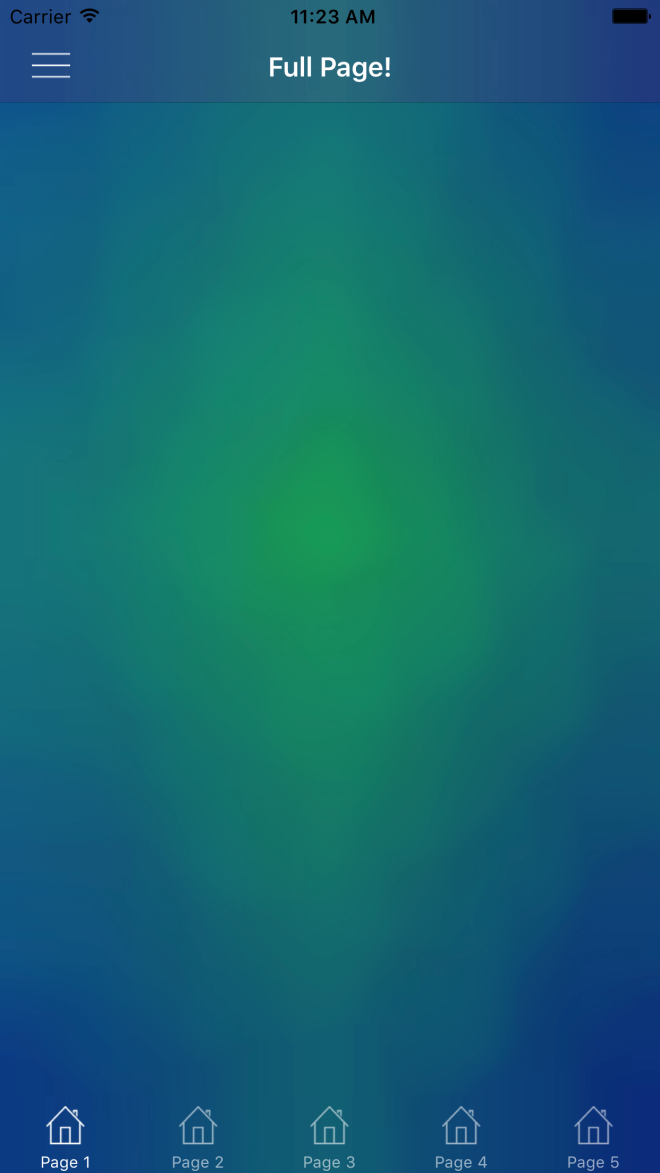
In a previous post, we talked about the iOS side of setting background images for both NavigationBars and TabBars. Beyond that, we looked at setting them so that we can simulate having transparent bars that show a background image behind the entire Page. That looked like this:

Simulator Screen Shot Apr 7, 2017, 11.23.33 AM

So now let’s do the same thing in Android!

Android

So Android handles images very differently compared to iOS, and also gives us a few easy ways to do what we want here. Rather than having to create custom renderers, we need to create Drawables for our images, and apply them in our Android Layouts for our Toolbar and TabBar. This approach is going to be more similar to Morgan Skinner’s approach for iOS here: http://www.morganskinner.com/2015/01/xamarin-formsusing-background-images-on.html

So we will need to crop our image where our Toolbar and Tabbar will be. If you are planning to also support landscape views, be sure to also crop the image separately for landscape and include those images in your appropriate drawables folders such as drawables-land-hdpi.

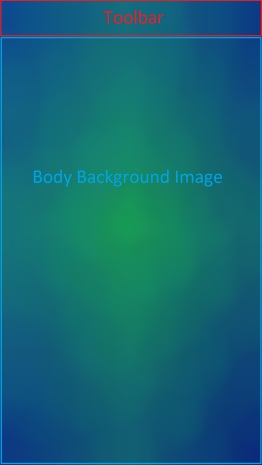
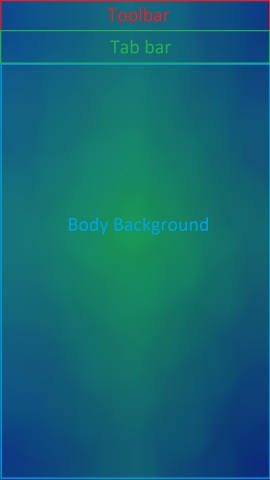
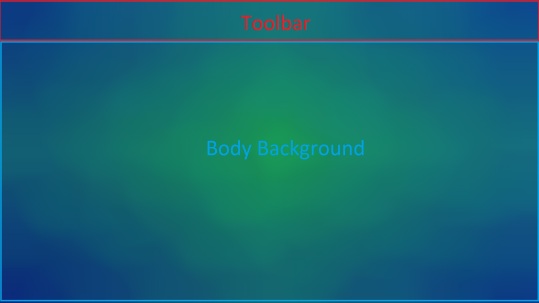
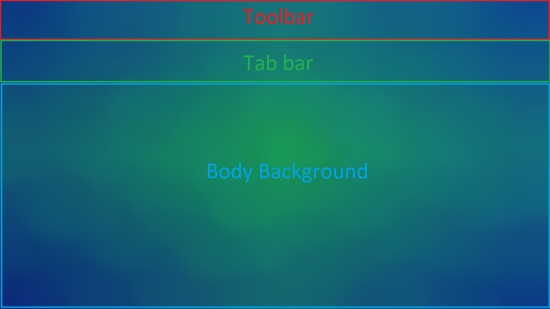
Another thing to consider is that, unlike in iOS, Android tabs are placed below the toolbar rather than at the bottom of the entire view. Because of this, you made need to use a different background for your pages that have a TabBar versus the pages that don’t. Here are some examples of how you might need to crop your images:

Portrait with no tabs

crop_portrait

Portrait with tabs

crop_portrait_tabs

Landscape with no tabs

crop_landscape

Landscape with tabs

crop_landscape_tabs

Be sure that you name the individual images the same, but place them in the appropriate resource folder as explained before. In this example we will call them:

  • toolbar_background.png
  • tabbar_background.png
  • page_background.png
  • tab_page_background.png

Unlike our iOS implementation, we do NOT need any custom renderers. Instead, we will set the background drawable of our layout files for our bars, and then in our xaml page, add an image to be the background.

Toolbar.axml

<?xml version="1.0" encoding="utf-8"?>
<android.support.v7.widget.Toolbar 
    xmlns:android="http://schemas.android.com/apk/res/android"
    xmlns:app="http://schemas.android.com/apk/res-auto"
    android:id="@+id/toolbar"
    android:layout_width="match_parent"
    android:layout_height="?attr/actionBarSize"
    android:minHeight="?attr/actionBarSize"
    android:background="@drawable/toolbar_background"
    android:theme="@style/ThemeOverlay.AppCompat.Dark.ActionBar"
    app:popupTheme="@style/ThemeOverlay.AppCompat.Light"
    app:layout_scrollFlags="scroll|enterAlways" /> 

Tabbar.axml

<?xml version="1.0" encoding="utf-8"?>
<android.support.design.widget.TabLayout         
    xmlns:android="http://schemas.android.com/apk/res/android"              
    xmlns:app="http://schemas.android.com/apk/res-auto"              
    android:id="@+id/sliding_tabs"     
    android:layout_width="match_parent"        
    android:layout_height="wrap_content"          
    android:background="@drawable/tabbar_background"          
    android:theme="@style/ThemeOverlay.AppCompat.Dark.ActionBar"          
    app:tabIndicatorColor="@android:color/white"
    app:tabGravity="fill"      
    app:tabMode="fixed" />

Then be sure to set the resources before starting Xamarin.Forms in your MainActivity:

MainActivity.cs

    public class MainActivity : global::Xamarin.Forms.Platform.Android.FormsAppCompatActivity
    {
        protected override void OnCreate(Bundle bundle)
        {
            TabLayoutResource = Resource.Layout.Tabbar;
            ToolbarResource = Resource.Layout.Toolbar;

            base.OnCreate(bundle);

            global::Xamarin.Forms.Forms.Init(this, bundle);
            LoadApplication(new App());

        }
    }

With all those things set, you can now use your background images on pages with or without tabs:

ContentPageWithTabs.xaml

<ContentPage ...>
    <Grid ...>
        <Image Source="tab_page_background.png" .../>
        <!-- The rest of your content on top of the image -->
    </Grid>
</ContentPage>

ContentPageWithNoTabs.xaml

<ContentPage ...>
    <Grid ...>
        <Image Source="page_background.png" .../>
        <!-- The rest of your content on top of the image -->
    </Grid>
</ContentPage>


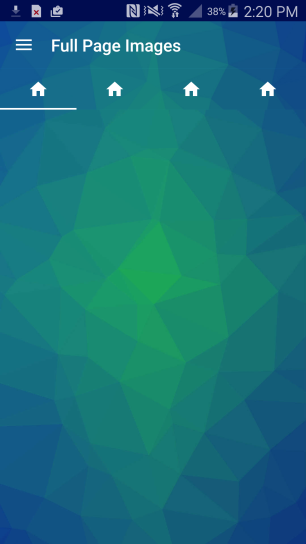
You can see an example result here (with a rushed crop job):

Screenshot_2017-04-18-14-20-08


If you like what you see, don’t forget to follow me on twitter @Suave_Pirate, check out my GitHub, and subscribe to my blog to learn more mobile developer tips and tricks!

Interested in sponsoring developer content? Message @Suave_Pirate on twitter for details.

Xamarin.Tips – MVVM Light Set Expressions Explained

I recently published a post about creating some Visual Studio code snippets for shorcutting the overhead of writing bindable properties and commands with MvvmLight. Xamarin.Tips – Visual Studio Code Templates/Snippets for MVVM Light

This post sparked some people who may or may not have used  Mvvm Light in the past to ask me about how it works underneath, and specifically the Set call made. For example:

private string _myText;

public string MyText
{
    get
    {
        return _myText;
    }
    set
    {
        // This is where the questions are.
        Set(() => MyText, ref _myText, value);
    }
}

I figured I would make another post to dissect this and explain what it is and how it is used!


First off, why are we doing this at all? What does this really do for us?

We use MvvmLight in order to create two-way or one-way bindings to our views whether that is in WPF, UWP, or Xamarin.Forms. The way these bindings are handled is by implementing INotifyPropertyChanged. When we implement INotifyPropertyChanged, we create a public event called PropertyChanged. PropertyChanged takes a custom EventArgs that includes the name of the property that was changed as a string. You would invoke that like this:

PropertyChanged?.Invoke(new PropertyChangedEventArgs("MyText"));

We can then have an event handler attached to this:

myViewModel.PropertyChanged += (sender, args) =>
{
    Console.WriteLine(args.PropertyName); // "MyText"
};

However, platforms such as WPF, UWP, and Xamarin give us the ability to use XAML to create these bindings like this (in Xamarin.Forms):

<Label Text="{Binding MyText}"/>

Setting bindings like this creates event handlers in the background if the BindingContext (or DataContext if you’re in UWP/WPF) implements INotifyPropertyChanged.

So now we can create auto-updating views with our bindings and calling PropertyChanged, but that’s a pain to do for every single property. That’s where libraries like MvvmLight come into play. They help handle a lot of the manual calls and ugly code. So now let’s look at what MvvmLight is really doing under the covers.

First, we need to look at the ViewModelBase class that MvvmLight ships and that contains the Set method we are talking about. ViewModelBase inherits from ObservableObject (another class MvvmLight), and ObservableObject is what is implementing INotifyPropertyChanged! We found it!

So how are ViewModelBase.Set and ObservableObject.Set making their way to calling PropertyChanged?

Let’s dissect the three parameters for the Set method used in the templates I created:

Set(() => MyText, ref _myText, value);
  1. The first is of type Expression<Func>. It is an expression that is returning the property that is calling it? This is where the fun stuff is really happening, so more on that later.
  2. The second is the underlying field that needs to be updated, passed in as a reference type rather than by value.
  3. The third is the new value that it is being set to.

The last two seem to make sense right away: what field are we updating, and what is the value we are setting it to? We need to pass the field in as a ref so that when we update it, it updates in the original model that passed it in rather than simply passing the value of the field into the method.

So what is that Expression?

The only thing left in order to call PropertyChanged is the name of the property being updated, so that must be what the property expression is for. Without decompiling the MvvmLight dlls and looking at the source code, we can infer how we might be able to pull the property name out of that Expression.

First, we need to get the Body of the Expression as a System.Linq.Expression.MemberExpression. The MemberExpression has a Member property which we can then pull property info from. We can cast that Member as a System.Reflection.PropertyInfo, and with that PropertyInfo, we can take the name of the property.

Expression<Func<string>> myTextExpression = () => MyText;
var body = myTextExpression.Body as MemberExpression;
var member = body.Member as PropertyInfo;
var finalPropertyName = member.Name; // we have it!

Then the final step is to finally invoke PropertyChanged with that property name.

I do also want to point out that although I use this particular Set method from MvvmLight, the ObservableObject and ViewModelBase do come with multiple overloads of Set that might work better for your preferred practices. For example, you can call Set without the property expression, and just pass the name of the property in directly. For example:

private string _myText;

public string MyText
{
    get
    {
        return _myText;
    }
    set
    {
        Set("MyText", ref _myText, value); 
    }
}

OR to be even more optimized, you can use nameof to get the name of the property without having to have string-literals floating around in your code:

private string _myText;

public string MyText
{
    get
    {
        return _myText;
    }
    set
    {
        Set(nameof(MyText), ref _myText, value); 
    }
}

Here are all the overloads available to use:

ViewModelBase.cs

protected bool Set<T>(Expression<Func<T>> propertyExpression, ref T field, T newValue, bool broadcast);
protected bool Set<T>(string propertyName, ref T field, T newValue = default(T), bool broadcast = false);
protected bool Set<T>(ref T field, T newValue = default(T), bool broadcast = false, [CallerMemberName] string propertyName = null);

ObservableObject.cs

// THIS IS THE ONE WE WERE USING
protected bool Set<T>(Expression<Func<T>> propertyExpression, ref T field, T newValue);
protected bool Set<T>(string propertyName, ref T field, T newValue);
protected bool Set<T>(ref T field, T newValue, [CallerMemberName] string propertyName = null);

If you happen to have any other questions about how this works, or about breaking down Expressions like we did, feel free to drop a comment on this post, or mention me on Twitter @Suave_Pirate.


And as always:


If you like what you see, don’t forget to follow me on twitter @Suave_Pirate, check out my GitHub, and subscribe to my blog to learn more mobile developer tips and tricks!

Interested in sponsoring your developer content? Message me on twitter @Suave_Pirate for details.

Xamarin.Tips – Removing the Bottom Border of Your iOS Navigation Bars

iOS UINavigationBars by default ship with a bottom border. If you want to remove it, all you need to do is update the ShadowImage of your UINavigationBar. Setting it to new UIImage() will do the trick. This might not be a universal solution. If you are doing more custom work or for certain layouts, you might need to take some additional steps including setting ClipsToBounds to true and setting the BackgroundImage of the UINavigationBar to a new UIImage() as well.

Here’s all of that together:

...
NavigationBar.ShadowImage = new UIImage();
NavigationBar.ClipsToBounds = true(); // optional
NavigationBar.BackgroundImage = new UIImage(); // optional
...

Of course, we are also going to talk about applying this in Xamarin.Forms!

If you want to apply this globally, you can create a custom renderer for NavigationPage. If you only want it in some situations, then you will need to create a new subclass of ContentPage and create a custom renderer for that page that will apply the same changes as below for our universal solution:

CustomNavigationRenderer.cs

[assembly: ExportRenderer(typeof(NavigationPage), typeof(CustomNavigationRenderer))]
namespace YOUR_IOS_NAMESPACE
{
    public class CustomNavigationRenderer : NavigationRenderer
    {
        public override void ViewDidLoad()
        {
            base.ViewDidLoad();

            NavigationBar.ShadowImage = new UIImage();
            NavigationBar.ClipsToBounds = true(); // optional
            NavigationBar.BackgroundImage = new UIImage(); // optional
        }

    }
}

One other way to do this is by using the Appearance API and apply it universally!

...
UINavigationBar.Appearance.ShadowImage = new UIImage();
...

Lastly, here’s is how this would look in Swift if you’ve landed here but aren’t using Xamarin and C#:

UINavigationBar.appearance().setBackgroundImage(
    UIImage(),
    forBarPosition: .Any,
    barMetrics: .Default)

UINavigationBar.appearance().shadowImage = UIImage()

or if you are for some reason in love with Obj-C:

[[UINavigationBar appearance] setBackgroundImage:[[UIImage alloc] init]
                                  forBarPosition:UIBarPositionAny
                                      barMetrics:UIBarMetricsDefault];

[[UINavigationBar appearance] setShadowImage:[[UIImage alloc] init]];


transnavbar


If you like what you see, don’t forget to follow me on twitter @Suave_Pirate, check out my GitHub, and subscribe to my blog to learn more mobile developer tips and tricks!

Xamarin.Tips – iOS Bar Background Images in Xamarin.Forms

Xamarin.Forms doesn’t ship with any way to provide images as your background of either NavigationBars or TabBars. So in order to do this, we will have to build some custom renderers.

iOS

Morgan skinner has a great post here about an approach that he took to apply background images to his NavigationBars: http://www.morganskinner.com/2015/01/xamarin-formsusing-background-images-on.html

The give you the synopsis, you take your entire background image, crop it, and apply the cropped piece as the background of the bar in your renderer.

Here’s a look at how he cropped his image:
Original Marked Up_thumb[5]

I want to take a different approach here and do this programmatically so that you can be EXACT in the background of the bar so that it can match the background of your image.

Although we are approaching this as if you are applying the background image to be the same as your page background image, the same principle applies if you just want to set any image.

Here’s a renderer to use for a NavigationBar:

BackgroundImageNavigationRenderer.cs

[assembly: ExportRenderer(typeof(NavigationPage), typeof(BackgroundImageNavigationRenderer))]
namespace YOUR_IOS_NAMESPACE
{
    public class BackgroundImageNavigationRenderer : NavigationRenderer
    {
        public override void ViewDidLoad()
        {
            base.ViewDidLoad();

            View.BackgroundColor = UIColor.Clear;
            NavigationBar.BackgroundColor = UIColor.Clear;
            var image = UIImage.FromBundle("YOUR_PAGE_BACKGROUND_IMAGE.png");
            image = image.Crop(0,
                (int)(image.CGImage.Height - NavigationBar.Frame.Height),
                (int)image.CGImage.Width,
                (int)NavigationBar.Frame.Height);
            image = image.Scale(new CGSize(NavigationBar.Frame.Width, NavigationBar.Frame.Height));
            NavigationBar.BarTintColor = UIColor.FromPatternImage(image);
            NavigationBar.ShadowImage = new UIImage();
        }

    }
}

Breaking it down, we are taking the image that we use as the background for our entire page, then opening cropping it to the size of the NavigationBar itself.

I’ve also created an extension method called Crop so that we can reuse it here and for our UITabBar:

ImageExtensions.cs

    public static class ImageExtensions
    {
        public static UIImage Crop(this UIImage image, int x, int y, int width, int height)
        {
            var imgSize = image.Size;

            UIGraphics.BeginImageContext(new SizeF(width, height));
            var imgToCrop = UIGraphics.GetCurrentContext();

            var croppingRectangle = new CGRect(0, 0, width, height);
            imgToCrop.ClipToRect(croppingRectangle);

            var drawRectangle = new CGRect(-x, -y, imgSize.Width, imgSize.Height);

            image.Draw(drawRectangle);
            var croppedImg = UIGraphics.GetImageFromCurrentImageContext();

            UIGraphics.EndImageContext();
            return croppedImg;
        }

    }

Now, if you are not doing this to have a full background image, and just want some image for your UINavigationBar only, you can do so like this:

BackgroundImageNavigationRenderer.cs

[assembly: ExportRenderer(typeof(NavigationPage), typeof(BackgroundImageNavigationRenderer))]
namespace YOUR_IOS_NAMESPACE
{
    public class BackgroundImageNavigationRenderer : NavigationRenderer
    {
        public override void ViewDidLoad()
        {
            base.ViewDidLoad();

            View.BackgroundColor = UIColor.Clear;
            NavigationBar.BackgroundColor = UIColor.Clear;
            var image = UIImage.FromBundle("YOUR_BAR_BACKGROUND_IMAGE.png");

            image = image.Scale(new CGSize(NavigationBar.Frame.Width, NavigationBar.Frame.Height));
            NavigationBar.BarTintColor = UIColor.FromPatternImage(image);
            NavigationBar.ShadowImage = new UIImage();
        }

    }
}

Essentially just cutting out the cropping process.

Also note that I set the NavigationBar.ShadowImage to a new UIImage();. Doing this gets rid of the line below your UINavigationBar. If you don’t want to remove the line, just don’t set the ShadowImage.

Now that we’ve done this for our UINavigationBar, we can apply the same thing to our UITabBars. So let’s create another custom renderer for that!

BackgroundImageTabbedPageRenderer.cs


[assembly: ExportRenderer(typeof(TabbedPage), typeof(BackgroundImageTabbedPageRenderer))]
namespace YOUR_IOS_NAMESPACE
{
    public class BackgroundImageTabbedPageRenderer : TabbedRenderer
    {
        public override void ViewWillLayoutSubviews()
        {
            base.ViewWillLayoutSubviews();

            var image = UIImage.FromBundle("YOUR_PAGE_BACKGROUND_IMAGE.jpg");
            image =image.Crop(0,
                (int)(image.CGImage.Height - TabBar.Frame.Height),
                (int)image.CGImage.Width,
                (int)TabBar.Frame.Height);
            image = image.Scale(new CGSize(TabBar.Frame.Width, TabBar.Frame.Height));
            TabBar.BackgroundImage = image;
            TabBar.UnselectedItemTintColor = UIColor.FromRGBA(255, 255, 255, 150);
            TabBar.ShadowImage = new UIImage();
        }

    }
}

just as we did with our UINavigationBar, we crop the page background image to the location and dimensions of our UITabBar, and set the background image there. The same thing also applies with removing the ShadowImage.

And if you are not using a full background image, and just want an image for your bar, take this:

BackgroundImageTabbedPageRenderer.cs


[assembly: ExportRenderer(typeof(TabbedPage), typeof(BackgroundImageTabbedPageRenderer))]
namespace YOUR_IOS_NAMESPACE
{
    public class BackgroundImageTabbedPageRenderer : TabbedRenderer
    {
        public override void ViewWillLayoutSubviews()
        {
            base.ViewWillLayoutSubviews();

            var image = UIImage.FromBundle("YOUR_PAGE_BACKGROUND_IMAGE.jpg");

            image = image.Scale(new CGSize(TabBar.Frame.Width, TabBar.Frame.Height));
            TabBar.BackgroundImage = image;
            TabBar.UnselectedItemTintColor = UIColor.FromRGBA(255, 255, 255, 150);
            TabBar.ShadowImage = new UIImage();
        }

    }
}

And now you can use full page images over your NavigationBars and TabBars, or just set an image as the background for your bars!


Simulator Screen Shot Apr 7, 2017, 11.23.33 AM

If you like what you see, don’t forget to follow me on twitter @Suave_Pirate, check out my GitHub, and subscribe to my blog to learn more mobile developer tips and tricks!

Xamarin.Tips – Sending Authorized SignalR Requests

In my last post, I talked about creating a CookieProvider for handling OAuth Bearer Tokens from an HTTP Cookie. Now that we have this capability, we can make a secure connection to SignalR using a Cookie store rather than adding our tokens to the Authorization HTTP Header.

By using cookies instead of the HTTP Header, we can now use a full Websocket connection rather than being forced into long polling. Using websockets increases speed of messages received and messages sent.

So here’s the quick bit of code for making a secure SignalR Websocket connection:

SignalRConnectionService.cs

    public class SignalRConnectionService
    {
        private HubConnection _connection;
        public IHubProxy AppHubProxy { get; set; }

        public SignalRConnectionService()
        {
            _connection = new HubConnection(YOUR_SIGNALR_URL);
            AppHubProxy = _connection.CreateHubProxy("AppHub");
        }

        public async Task StartAsync()
        {
            try
            {
                if(_connection.State != ConnectionState.Disconnected)
                {
                    _connection.Stop();
                }
                _connection.CookieContainer = new CookieContainer();
                _connection.CookieContainer.Add(new Uri(THE_BASE_URL_OF_YOUR_SERVER), new Cookie("BearerToken", YOUR_ACCESS_TOKEN));
                await _connection.Start();
               
        }
        public void Stop()
        {
            _connection.Stop();
        }
    }

Now we have the full speed of websockets enabled in our Xamarin, Mac, and Windows applications!

If you like what you see, don’t forget to follow me on twitter @Suave_Pirate, check out my GitHub, and subscribe to my blog to learn more mobile developer tips and tricks!

Xamarin.Controls – Xamarin.Forms PinView

In  previous post, I talked about creating a BorderlessEntry view using a Custom Renderer (or an alternative Effect). We are going to use said control in this post, so you can find it here: Xamarin.Forms Borderless Entry
On top of this control, we are also going to use a custom behavior mentioned in a blog post here: Xamarin.Tips – Restrict the Length of Your Entry Text

Now let’s talk about giving your users the ability to create a PIN to secure their account in your app while giving them a nice experience. The solution is the PinView!

We are going to build this as a custom component in Xamarin.Forms:

PinView.xaml

<ContentView xmlns="http://xamarin.com/schemas/2014/forms"               xmlns:x="http://schemas.microsoft.com/winfx/2009/xaml"               xmlns:behaviors="clr-namespace:YOUR_NAMESPACE.Behaviors;assembly=YOUR_NAMESPACE"              xmlns:views="clr-namespace:YOUR_NAMESPACE;assembly=YOUR_NAMESPACE"              x:Class="YOUR_NAMESPACE.PinView">
    <ContentView.Resources>
        <ResourceDictionary>
<Style x:Key="PinEntry" TargetType="Entry">
                <Setter Property="Keyboard" Value="Numeric"/>
                <Setter Property="IsPassword" Value="True"/>
                <Setter Property="WidthRequest" Value="50"/>
                <Setter Property="HeightRequest" Value="50"/>
                <Setter Property="Margin" Value="8,0"/>
                <Setter Property="HorizontalTextAlignment" Value="Center"/>
            </Style>
<Style x:Key="BottomBar" TargetType="BoxView">
                <Setter Property="HeightRequest" Value="2"/>
                <Setter Property="BackgroundColor" Value="White"/>
                <Setter Property="WidthRequest" Value="50"/>
                <Setter Property="VerticalOptions" Value="Start"/>
                <Setter Property="Margin" Value="0"/>
            </Style>

        </ResourceDictionary>
    </ContentView.Resources>
  <ContentView.Content>
        <StackLayout Orientation="Horizontal" HorizontalOptions="FillAndExpand">
            <StackLayout Orientation="Vertical">
                <views:BorderlessEntry x:Name="Pin1" Style="{StaticResource PinEntry}" TextColor="White">
                    <Entry.Behaviors>
                        <behaviors:EntryLengthValidatorBehavior MaxLength="1"/>
                    </Entry.Behaviors>
                </views:BorderlessEntry>
                <BoxView Style="{StaticResource BottomBar}"/>
            </StackLayout>

            <StackLayout Orientation="Vertical">
                <views:BorderlessEntry x:Name="Pin2" Style="{StaticResource PinEntry}" TextColor="White">
                    <Entry.Behaviors>
                        <behaviors:EntryLengthValidatorBehavior MaxLength="1"/>
                    </Entry.Behaviors>
                </views:BorderlessEntry>
                <BoxView Style="{StaticResource BottomBar}"/>
            </StackLayout>
            <StackLayout Orientation="Vertical">
                <views:BorderlessEntry x:Name="Pin3" Style="{StaticResource PinEntry}" TextColor="White">
                    <Entry.Behaviors>
                        <behaviors:EntryLengthValidatorBehavior MaxLength="1"/>
                    </Entry.Behaviors>
                </views:BorderlessEntry>
                <BoxView Style="{StaticResource BottomBar}"/>
            </StackLayout>
            <StackLayout Orientation="Vertical">
                <views:BorderlessEntry x:Name="Pin4" Style="{StaticResource PinEntry}" TextColor="White">
                    <Entry.Behaviors>
                        <behaviors:EntryLengthValidatorBehavior MaxLength="1"/>
                    </Entry.Behaviors>
                </views:BorderlessEntry>
                <BoxView Style="{StaticResource BottomBar}"/>
            </StackLayout>
        </StackLayout>
  </ContentView.Content>
</ContentView>

Lastly, we add some behaviors to our code-behind:

PinView.xaml.cs

 public partial class PinView : ContentView
    {
        public static BindableProperty PinProperty = BindableProperty.Create("Pin", typeof(string), typeof(PinView), defaultBindingMode: BindingMode.OneWayToSource);
        public string Pin
        {
            get
            {
                return (string)GetValue(PinProperty);
            }
            set
            {
                SetValue(PinProperty, value);
            }
        }
        public PinView()
        {
            InitializeComponent();
            Pin = string.Empty;
            Pin1.TextChanged += Pin1_TextChanged;
            Pin2.TextChanged += Pin2_TextChanged;
            Pin3.TextChanged += Pin3_TextChanged;
            Pin4.TextChanged += Pin4_TextChanged;
        }

        private void Pin4_TextChanged(object sender, TextChangedEventArgs e)
        {
            if (Pin4.Text.Length > 0)
                Pin4.Unfocus();
            else
                Pin3.Focus();
            Pin = Pin1.Text + Pin2.Text + Pin3.Text + Pin4.Text;
        }

        private void Pin3_TextChanged(object sender, TextChangedEventArgs e)
        {
            if (Pin3.Text.Length > 0)
                Pin4.Focus();
            else
                Pin2.Focus();
            Pin = Pin1.Text + Pin2.Text + Pin3.Text + Pin4.Text;
        }

        private void Pin2_TextChanged(object sender, TextChangedEventArgs e)
        {
            if (Pin2.Text.Length > 0)
                Pin3.Focus();
            else
                Pin1.Focus();
            Pin = Pin1.Text + Pin2.Text + Pin3.Text + Pin4.Text;
        }

        private void Pin1_TextChanged(object sender, TextChangedEventArgs e)
        {
            if (Pin1.Text.Length > 0)
                Pin2.Focus();
            Pin = Pin1.Text + Pin2.Text + Pin3.Text + Pin4.Text;
        }
    }

If we dig into the behavior, we set up our TextChanged events so that when each separate Entry is updated, we move the focus to the next Entry. If we clear the text of one of the Entries, we move to the Entry before it, and when we write text into the Entry, we move to the next one.

We also use the Behavior mentioned to restrict the user from entering more than 1 character in each Entry!

If you like what you see, don’t forget to follow me on twitter @Suave_Pirate, check out my GitHub, and subscribe to my blog to learn more mobile developer tips and tricks!