Generating Unique Ids on the Fly

Let’s do some JavaScript!

This post may be a little off-topic from my normal content, although it isn’t Xamarin, it could be used for hybrid frameworks like Ionic or base Cordova.

What we’re going to do is look at ways to generate unique ids on the fly for anchor tags. This could be used to help with your Google analytics or general user interaction tracking.

First thing we need is a function to generate the ids:


var lastId = 0;
function uniqueId(prefix){
    lastId++;
    return prefix+lastId;
}

Now what we need to do is use this function to set the ids on all our anchors:


document.addEventListener("DOMContentLoaded", function(event) {
    var anchors = document.getElementsByTagName("a")
    for(var i = 0; i < anchors.length; i++){
        anchors[i].id = uniqueId("generatedId");
    }
});

Doing it this way ensures that our ids are the same each time we load the page since it is based on their position when the DOM is loaded. This set up isn’t fool proof, obviously. If your page’s content is inconsistent, tags could end up with different ids than they had before. Some of these problems can be handled better by using a smarter prefix for your id.

Xamarin.Tips – Calling Platform-Specific Code from a Portable Class Library – The Singleton Method

For those who just want code: https://github.com/SuavePirate/Xamarin.HockeyApp.Portable

For those who just want the video: [VIDEO] Xamarin.Tips: Calling Platform-Specific Code from a PCL (Singleton Method)

As we develop our applications to be cross-platform, we try to share as much code between different platforms as possible. Many times, though, we have a need to call platform-specific code from that shared code; whether it be something such as playing a sound file, handling hardware readings, or using a third-party SDK that isn’t abstracted to be shareable.

In these examples, we will look at implementing parts of the HockeyApp SDK that are specific to the platform you are running against such as showing the Feedback control to ask your users to report bugs or give feedback.

There are a few ways to accomplish this, but in this post, we will look at using the Singleton Method.

The Singleton Method is where we create a universal Singleton in our shared code that is initialized in our platform code, and then called from our shared code.

To start, in our shared code, we will create an interface that will be implemented on our platforms:

public interface IHockeyService
{
    void Init();
    void GetFeedback();
}

Then we create our actual Singleton in our shared code:

public class HockeyManager
{
    public static IHockeyService Current;
}

Now in our platform projects, we will implement our IHockeyService:

iOS:

public class HockeyService : IHockeyService
{
    public HockeyService()
    {
    }

    public void GetFeedback()
    {
        BITHockeyManager.SharedHockeyManager.FeedbackManager.ShowFeedbackListView();
    }

    public void Init()
    {
        var manager = BITHockeyManager.SharedHockeyManager;
        manager.Configure("HOCKEY_APP_ID");
        manager.StartManager();
    }
}

Android:

public class HockeyService : IHockeyService
{
    private const string HOCKEYAPP_KEY = "HOCKEY_APP_ID";
    private readonly Android.App.Application _androidApp;
    private readonly Activity _context;

    public HockeyAppService(Activity context, Android.App.Application androidApp)
    {
        _context = context;
        _androidApp = androidApp;
    }

    public void GetFeedback()
    {
        FeedbackManager.ShowFeedbackActivity(_context.ApplicationContext);
    }

    public void Initialize()
    {
        CrashManager.Register(_context, HOCKEYAPP_KEY);
        MetricsManager.Register(_androidApp, HOCKEYAPP_KEY);
        UpdateManager.Register(_context, HOCKEYAPP_KEY);
        FeedbackManager.Register(_context, HOCKEYAPP_KEY);
    }
}

Now we need to initialize our Singleton from our platform-specific code. In iOS, we will do this in our AppDelegate, and in Android – our MainActivity:

iOS

public override bool FinishedLaunching(UIApplication app, NSDictionary options)
{
    HockeyManager.Current = new HockeyService();
    global::Xamarin.Forms.Forms.Init();
    LoadApplication(new App());

    return base.FinishedLaunching(app, options);
}

Android:

protected override void OnCreate(Bundle bundle)
{
    TabLayoutResource = Resource.Layout.Tabbar;
    ToolbarResource = Resource.Layout.Toolbar;
    base.OnCreate(bundle);
    HockeyManager.Current = new HockeyService(this, Application);
    global::Xamarin.Forms.Forms.Init(this, bundle);
    LoadApplication(new App());
}

Now we need to initialize the HockeyApp manager from our shared code.

App.xaml.cs

public App ()
{
    HockeyManager.Current.Init();
}

Now that our Singleton is created, we can make calls to it from our Shared code. In this example, we will add a button to a Xamarin.Forms page with a click handler that calls the service:

<?xml version="1.0" encoding="utf-8" ?>
<ContentPage xmlns="http://xamarin.com/schemas/2014/forms" xmlns:x="http://schemas.microsoft.com/winfx/2009/xaml" x:Class="YourNamespace.MainPage">

    <Button Text="Get feedback with a singleton!"
            VerticalOptions="Center"
            HorizontalOptions="Center"
            Clicked="Feedback_Clicked"/>

</ContentPage>
public partial class MainPage : ContentPage
{
    public MainPage()
    {
        InitializeComponent();
    }

    private void Feedback_Clicked(object sender, EventArgs e)
    {
        HockeyManager.Current.GetFeedback();
    }
}

Now our results will show that our shared code call to the Singleton successfully shows the HockeyApp UI


simulator-screen-shot-feb-15-2017-1-47-26-pm

Xamarin.University Guest Lecture – Xamarin.Flux

Excited to announce I’ll be instructing a lecture on Xamarin University on February 23rd, 2017!

Be sure to come check it out: https://university.xamarin.com/guestlectures/architecting-your-app-with-xamarin-facebook-flux 

The topic is on using the Flux design pattern to build Xamarin applications as seen in my video and GitHub.

Xamarin.Android Continuous Integration with Visual Studio Team Services

Have you or someone you know been physically harmed or emotionally scarred by the stress of setting up Continuous Integration on VSTS for your Xamarin.Android project? If your answer is yes, you are entitled to no compensation, but this blog post might help.

Easily one of the most frustrating experiences I’ve had with CI so far. It seemed that after I worked through one issue breaking the build, another two popped up. It’s like fighting the Hydra of builds.

Of course everything built fine on my local machine as well as on my other developers’ machines! So WTF VSTS???

Let’s look at some common errors you might have run into. If none of these cover your problems, leave a comment and we can try to sort it out after.

“Major version 51 is newer than 50, the highest major version supported by this compiler.”

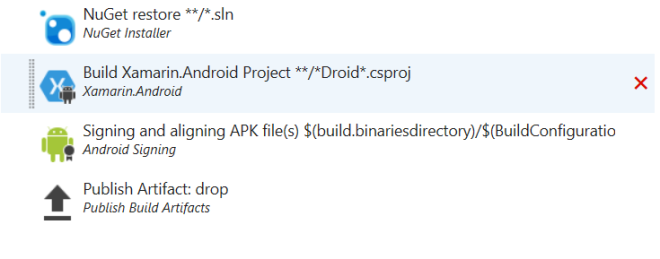
Maybe you’ve run into this problem during your actual builds in the past. Basically the issue is that the latest Android Support Libraries build with a newer version of the compiler. The fix is simple – in VSTS, set your JDK version explicitly to 8.

  1. In your build definition, go to your Build Xamarin.Android project step
    vstsdroid
  2. Scroll down the the JDK options section
  3. Select JDK Version 
  4. Select JDK 8 from the JDK Version dropdown
    VSTSJDK.PNG
  5. Save
  6. Run


“java.lang.OutOfMemoryError. Consider increasing the value of $(JavaMaximumHeapSize)”

The error is at least pretty explanatory. You ran out of memory in your Java Heap.

The solution is to increase your Java Heap explicitly:

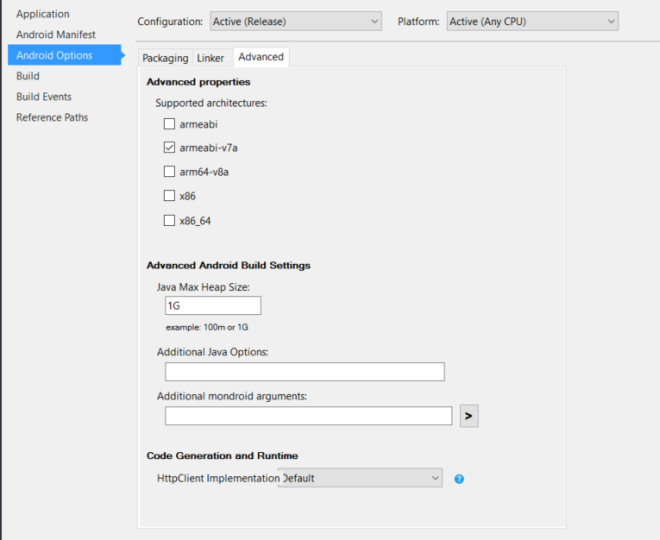
  1. In your IDE (VS or XS), go to your Android project
  2. Open the properties for your project
  3. Set your configuration to Release (or whatever configuration your VSTS build runs as)
  4. Go to the Android Options Tab
  5. Go to the Advanced tab
  6. Go down to the Advanced Android Build Settings
  7. Set the Java Max Heap Size to something larger such as “1G”

javaheap


These errors can be common and are only applicable to basic Android builds. This does not cover Continuous Deployment to services such as HockeyApp or Visual Studio Mobile Center.

Don’t forget to leave a comment if you’ve run into any different issues!

[Video] Xamarin.Flux

Learn how to use the Flux design pattern with Xamarin.

Source code: https://github.com/SuavePirate/Xamarin.Flux

[Video Series] Xamarin.Tips: Calling Platform-Specific Code from a PCL

Learn how to use 4 methods to call platform specific code from shared code in Xamarin. Make calls to the HockeyApp iOS SDK from a Portable Class Library.

  1. Singleton Method
  2. Xamarin.Forms Dependency Service
  3. Service Locator
  4. Dependency Injection


Source Code: https://github.com/SuavePirate/Xamarin.HockeyApp.Portable 

[VIDEO] Xamarin.Tips: Calling Platform-Specific Code from a PCL (All 4 Methods)

Using all 4 methods to call platform specific code from shared code in Xamarin. Make calls to the HockeyApp iOS SDK from a Portable Class Library.


Source Code: https://github.com/SuavePirate/Xamarin.HockeyApp.Portable 

[VIDEO] Xamarin.Tips: Calling Platform-Specific Code from a PCL (Dependency Injection)

Using Dependency Injection to call platform specific code from shared code in Xamarin. Make calls to the HockeyApp iOS SDK from a Portable Class Library.


Source Code: https://github.com/SuavePirate/Xamarin.HockeyApp.Portable 

[VIDEO] Xamarin.Tips: Calling Platform-Specific Code from a PCL (Service Locator {anti}Pattern)

Using the Service Locator anti-pattern to call platform specific code from shared code in Xamarin. Make calls to the HockeyApp iOS SDK from a Portable Class Library.


Source Code: https://github.com/SuavePirate/Xamarin.HockeyApp.Portable 

[VIDEO] Xamarin.Tips: Calling Platform-Specific Code from a PCL (Xamarin.Forms DependencyService)


Using the Xamarin.Forms DependencyService class to call platform specific code from shared code in Xamarin. Make calls to the HockeyApp iOS SDK from a Portable Class Library.


Source Code: https://github.com/SuavePirate/Xamarin.HockeyApp.Portable