Xamarin.Tip – Borderless TimePicker

I previously put out a post on removing the border of a Xamarin.Forms Entry which was then used to create a custom PinView as well as a MaterialEntry that follows the material design standards for text fields. I also added a post just like this one that talks about creating a BorderlessPicker. Check those out here:

In this post, we’ll do exactly what we did with the BorderlessPicker, but apply it to the Xamarin.Forms.TimePicker control to remove the border. This would ideally be done using an Effect, however we will be using this control in a later post to create a MaterialTimePicker to fit the Material Design standards for form inputs, so we will create custom renderers for Android, iOS, and UWP.

You can find this code as part of my library in progress to create Material Design Form controls for Xamarin.Forms – https://github.com/SuavePirate/SuaveControls.MaterialFormControls.

Let’s get started with our custom control by first creating a custom subclass of Xamarin.Forms.TimePicker followed by a custom renderer class for iOS, Android, and UWP that kills the border.

BorderlessTimePicker.cs

namespace SuaveControls.MaterialForms
{
    public class BorderlessTimePicker : TimePicker
    {
    }
}

Nothing special here since we are using the default behavior of the TimePicker.

Android

Now let’s create an Android custom renderer.

BorderlessTimePickerRenderer.cs – Android

[assembly: ExportRenderer(typeof(BorderlessTimePicker), typeof(BorderlessTimePickerRenderer))]
namespace SuaveControls.MaterialForms.Android.Renderers
{
    public class BorderlessTimePickerRenderer : TimePickerRenderer
    {
        public static void Init() { }
        protected override void OnElementChanged(ElementChangedEventArgs<TimePicker> e)
        {
            base.OnElementChanged(e);
            if (e.OldElement == null)
            {
                Control.Background = null;

                var layoutParams = new MarginLayoutParams(Control.LayoutParameters);
                layoutParams.SetMargins(0, 0, 0, 0);
                LayoutParameters = layoutParams;
                Control.LayoutParameters = layoutParams;
                Control.SetPadding(0, 0, 0, 0);
                SetPadding(0, 0, 0, 0);
            }
        }
    }
}

We simple kill the default padding and margins while setting the Background property to null. This Background is what creates the drawable underline for the AppCompat TimePicker.

iOS

Follow with an iOS renderer.

BorderlessTimePickerRenderer.cs – iOS

[assembly: ExportRenderer(typeof(BorderlessTimePicker), typeof(BorderlessTimePickerRenderer))]
namespace SuaveControls.MaterialForms.iOS.Renderers
{
    public class BorderlessTimePickerRenderer : TimePickerRenderer
    {
        public static void Init() { }
        protected override void OnElementPropertyChanged(object sender, PropertyChangedEventArgs e)
        {
            base.OnElementPropertyChanged(sender, e);

            Control.Layer.BorderWidth = 0;
            Control.BorderStyle = UITextBorderStyle.None;
        }
    }
}

All we do here is set the BorderWidth to 0 and the BorderStyle to UITextBorderStyle.None.

UWP

Lastly a renderer for UWP

BorderlessTimePickerRenderer.cs – UWP


[assembly: ExportRenderer(typeof(BorderlessTimePicker), typeof(BorderlessTimePickerRenderer))]

namespace SuaveControls.MaterialForms.UWP.Renderers
{
    public class BorderlessTimePickerRenderer : TimePickerRenderer
    {
        public static void Init() { }
        protected override void OnElementChanged(ElementChangedEventArgs<TimePicker> e)
        {
            base.OnElementChanged(e);

            if (Control != null)
            {
                Control.BorderThickness = new Windows.UI.Xaml.Thickness(0);
                Control.Margin = new Windows.UI.Xaml.Thickness(0);
                Control.Padding = new Windows.UI.Xaml.Thickness(0);
            }
        }
    }
}

Similar to how we did it on Android, we set both the Margin and Padding to 0 and also set the BorderThickness to a 0’d Thickness.

Using the BorderlessTimePicker

Now you can use the BorderlessTimePicker in your XAML or C# code:

MainPage.xaml

<?xml version="1.0" encoding="utf-8" ?>
<ContentPage xmlns="http://xamarin.com/schemas/2014/forms"
             xmlns:x="http://schemas.microsoft.com/winfx/2009/xaml"
             xmlns:local="clr-namespace:ExampleMaterialApp"
             xmlns:suave="clr-namespace:SuaveControls.MaterialForms;assembly=SuaveControls.MaterialForms"
             x:Class="ExampleMaterialApp.MainPage">

    <ScrollView>
        <StackLayout Spacing="16" Margin="16">
            <Label Text="Borderless TimePicker!" Margin="32" HorizontalOptions="Center" HorizontalTextAlignment="Center"/>
            <suave:BorderlessTimePicker/>

        </StackLayout>
    </ScrollView>

</ContentPage>

Check out those results on iOS:

If you like what you see, don’t forget to follow me on twitter @Suave_Pirate, check out my GitHub, and subscribe to my blog to learn more mobile developer tips and tricks!

Interested in sponsoring developer content? Message @Suave_Pirate on twitter for details.

Xamarin.Tip – Borderless DatePicker

I previously put out a post on removing the border of a Xamarin.Forms Entry which was then used to create a custom PinView as well as a MaterialEntry that follows the material design standards for text fields. I also added a post just like this one that talks about creating a BorderlessPicker. Check those out here:

In this post, we’ll do exactly what we did with the BorderlessPicker, but apply it to the Xamarin.Forms.DatePicker control to remove the border. This would ideally be done using an Effect, however we will be using this control in a later post to create a MaterialDatePicker to fit the Material Design standards for form inputs, so we will create custom renderers for Android, iOS, and UWP.

You can find this code as part of my library in progress to create Material Design Form controls for Xamarin.Forms – https://github.com/SuavePirate/SuaveControls.MaterialFormControls.

Let’s get started with our custom control by first creating a custom subclass of Xamarin.Forms.DatePicker followed by a custom renderer class for iOS, Android, and UWP that kills the border.

BorderlessDatePicker.cs

namespace SuaveControls.MaterialForms
{
    public class BorderlessDatePicker : DatePicker
    {
    }
}

Nothing special here since we are using the default behavior of the DatePicker.

Android

Now let’s create an Android custom renderer.

BorderlessDatePickerRenderer.cs – Android

[assembly: ExportRenderer(typeof(BorderlessDatePicker), typeof(BorderlessDatePickerRenderer))]
namespace SuaveControls.MaterialForms.Android.Renderers
{
    public class BorderlessDatePickerRenderer : DatePickerRenderer
    {
        public static void Init() { }
        protected override void OnElementChanged(ElementChangedEventArgs<DatePicker> e)
        {
            base.OnElementChanged(e);
            if (e.OldElement == null)
            {
                Control.Background = null;

                var layoutParams = new MarginLayoutParams(Control.LayoutParameters);
                layoutParams.SetMargins(0, 0, 0, 0);
                LayoutParameters = layoutParams;
                Control.LayoutParameters = layoutParams;
                Control.SetPadding(0, 0, 0, 0);
                SetPadding(0, 0, 0, 0);
            }
        }
    }
}

We simple kill the default padding and margins while setting the Background property to null. This Background is what creates the drawable underline for the AppCompat DatePicker.

iOS

Follow with an iOS renderer.

BorderlessDatePickerRenderer.cs – iOS

[assembly: ExportRenderer(typeof(BorderlessDatePicker), typeof(BorderlessDatePickerRenderer))]
namespace SuaveControls.MaterialForms.iOS.Renderers
{
    public class BorderlessDatePickerRenderer : DatePickerRenderer
    {
        public static void Init() { }
        protected override void OnElementPropertyChanged(object sender, PropertyChangedEventArgs e)
        {
            base.OnElementPropertyChanged(sender, e);

            Control.Layer.BorderWidth = 0;
            Control.BorderStyle = UITextBorderStyle.None;
        }
    }
}

All we do here is set the BorderWidth to 0 and the BorderStyle to UITextBorderStyle.None.

UWP

Lastly a renderer for UWP

BorderlessDatePickerRenderer.cs – UWP


[assembly: ExportRenderer(typeof(BorderlessDatePicker), typeof(BorderlessDatePickerRenderer))]

namespace SuaveControls.MaterialForms.UWP.Renderers
{
    public class BorderlessDatePickerRenderer : DatePickerRenderer
    {
        public static void Init() { }
        protected override void OnElementChanged(ElementChangedEventArgs<DatePicker> e)
        {
            base.OnElementChanged(e);

            if (Control != null)
            {
                Control.BorderThickness = new Windows.UI.Xaml.Thickness(0);
                Control.Margin = new Windows.UI.Xaml.Thickness(0);
                Control.Padding = new Windows.UI.Xaml.Thickness(0);
            }
        }
    }
}

Similar to how we did it on Android, we set both the Margin and Padding to 0 and also set the BorderThickness to a 0’d Thickness.

Using the BorderlessDatePicker

Now you can use the BorderlessDatePicker in your XAML or C# code:

MainPage.xaml

<?xml version="1.0" encoding="utf-8" ?>
<ContentPage xmlns="http://xamarin.com/schemas/2014/forms"
             xmlns:x="http://schemas.microsoft.com/winfx/2009/xaml"
             xmlns:local="clr-namespace:ExampleMaterialApp"
             xmlns:suave="clr-namespace:SuaveControls.MaterialForms;assembly=SuaveControls.MaterialForms"
             x:Class="ExampleMaterialApp.MainPage">

    <ScrollView>
        <StackLayout Spacing="16" Margin="16">
            <Label Text="Borderless DatePicker!" Margin="32" HorizontalOptions="Center" HorizontalTextAlignment="Center"/>
            <suave:BorderlessDatePicker/>

        </StackLayout>
    </ScrollView>

</ContentPage>

Check out those results on iOS:

If you like what you see, don’t forget to follow me on twitter @Suave_Pirate, check out my GitHub, and subscribe to my blog to learn more mobile developer tips and tricks!

Interested in sponsoring developer content? Message @Suave_Pirate on twitter for details.

Xamarin.Tip – Borderless Picker

I previously put out a post on removing the border of a Xamarin.Forms Entry which was then used to create a custom PinView as well as a MaterialEntry that follows the material design standards for text fields. Check those out here:

In this post, we’ll apply some of the same principles to create a BorderlessPicker. It’s going to use a simple custom renderer, although this could and should be done using an Effect if being used on its own. However, this BorderlessPicker will be the foundation for future controls we will create such as the MaterialPicker that applies Material Design standards to the Xamarin.Forms Picker control on Android, iOS, and UWP.

You can find this code as part of my library in progress to create Material Design Form controls for Xamarin.Forms – https://github.com/SuavePirate/SuaveControls.MaterialFormControls.

Let’s get started with our custom control by first creating a custom subclass of Xamarin.Forms.Picker followed by a custom renderer class for iOS, Android, and UWP that kills the border.

BorderlessPicker.cs

namespace SuaveControls.MaterialForms
{
    public class BorderlessPicker : Picker
    {
    }
}

Nothing special here since we are using the default behavior of the Picker.

Android

Now let’s create an Android custom renderer.

BorderlessPickerRenderer.cs – Android

[assembly: ExportRenderer(typeof(BorderlessPicker), typeof(BorderlessPickerRenderer))]
namespace SuaveControls.MaterialForms.Android.Renderers
{
    public class BorderlessPickerRenderer : PickerRenderer
    {
        public static void Init() { }
        protected override void OnElementChanged(ElementChangedEventArgs<Picker> e)
        {
            base.OnElementChanged(e);
            if (e.OldElement == null)
            {
                Control.Background = null;

                var layoutParams = new MarginLayoutParams(Control.LayoutParameters);
                layoutParams.SetMargins(0, 0, 0, 0);
                LayoutParameters = layoutParams;
                Control.LayoutParameters = layoutParams;
                Control.SetPadding(0, 0, 0, 0);
                SetPadding(0, 0, 0, 0);
            }
        }
    }
}

We simple kill the default padding and margins while setting the Background property to null. This Background is what creates the drawable underline for the AppCompat Picker.

iOS

Follow with an iOS renderer.

BorderlessPickerRenderer.cs – iOS

[assembly: ExportRenderer(typeof(BorderlessPicker), typeof(BorderlessPickerRenderer))]
namespace SuaveControls.MaterialForms.iOS.Renderers
{
    public class BorderlessPickerRenderer : PickerRenderer
    {
        public static void Init() { }
        protected override void OnElementPropertyChanged(object sender, PropertyChangedEventArgs e)
        {
            base.OnElementPropertyChanged(sender, e);

            Control.Layer.BorderWidth = 0;
            Control.BorderStyle = UITextBorderStyle.None;
        }
    }
}

All we do here is set the BorderWidth to 0 and the BorderStyle to UITextBorderStyle.None.

UWP

Lastly a renderer for UWP

BorderlessPickerRenderer.cs – UWP


[assembly: ExportRenderer(typeof(BorderlessPicker), typeof(BorderlessPickerRenderer))]

namespace SuaveControls.MaterialForms.UWP.Renderers
{
    public class BorderlessPickerRenderer : PickerRenderer
    {
        public static void Init() { }
        protected override void OnElementChanged(ElementChangedEventArgs<Picker> e)
        {
            base.OnElementChanged(e);

            if (Control != null)
            {
                Control.BorderThickness = new Windows.UI.Xaml.Thickness(0);
                Control.Margin = new Windows.UI.Xaml.Thickness(0);
                Control.Padding = new Windows.UI.Xaml.Thickness(0);
            }
        }
    }
}

Similar to how we did it on Android, we set both the Margin and Padding to 0 and also set the BorderThickness to a 0’d Thickness.

Using the BorderlessPicker

Now you can use the BorderlessPicker in your XAML or C# code:

MainPage.xaml

<?xml version="1.0" encoding="utf-8" ?>
<ContentPage xmlns="http://xamarin.com/schemas/2014/forms"
             xmlns:x="http://schemas.microsoft.com/winfx/2009/xaml"
             xmlns:local="clr-namespace:ExampleMaterialApp"
             xmlns:suave="clr-namespace:SuaveControls.MaterialForms;assembly=SuaveControls.MaterialForms"
             x:Class="ExampleMaterialApp.MainPage">

    <ScrollView>
        <StackLayout Spacing="16" Margin="16">
            <Label Text="Borderless Picker!" Margin="32" HorizontalOptions="Center" HorizontalTextAlignment="Center"/>
            <suave:BorderlessPicker x:Name="PickerDemo" Title="Options"/>

        </StackLayout>
    </ScrollView>

</ContentPage>

MainPage.xaml.cs

    public partial class MainPage : ContentPage
    {
        public MainPage()
        {
            InitializeComponent();

            PickerDemo.ItemsSource = new List<string>
            {
                "Option 1",
                "Option 2",
                "Option 3",
                "Option 4"
            };
        }
    }

Check out those results on iOS:

If you like what you see, don’t forget to follow me on twitter @Suave_Pirate, check out my GitHub, and subscribe to my blog to learn more mobile developer tips and tricks!

Interested in sponsoring developer content? Message @Suave_Pirate on twitter for details.

Xamarin.Control – Xamarin.Forms MaterialEntry

Back by popular demand, bringing more Material Design controls to you Xamarin.Forms app! This time we will look at implementing the standards in Material Design’s text fields by building a MaterialEntry control. You can find the source code and example app here: https://github.com/SuavePirate/MaterialEntry but you can build your own by following this post.

Let’s build our Xamarin.Forms control to work the same on not only Android where Material Design is baked in, but also to run on iOS AND UWP. In the end, we should be able to use our floating label, set an accent color that expands on the label and underline when focused while being able to bind these properties through MVVM.

Simulator Screen Shot Jul 14, 2017, 3.42.03 PM

The first thing we need to do is create a BorderlessEntry that removes the border from our entry on all 3 platforms. I’ve done this in a previous blog post here: Xamarin.Forms Borderless Entry, so we won’t be implementing it here. This code is also in the GitHub link above.

With our BorderlessEntry we can now create our custom control WITHOUT ANY MORE CUSTOM RENDERERS!

Let’s set up the layout structure in our XAML file, and then wire up the animation logic in our code behind.

MaterialEntry.xaml

<?xml version="1.0" encoding="UTF-8"?>
<ContentView xmlns="http://xamarin.com/schemas/2014/forms"               xmlns:x="http://schemas.microsoft.com/winfx/2009/xaml"              xmlns:local="clr-namespace:SuaveControls.MaterialEntry"              x:Class="SuaveControls.MaterialEntry.MaterialEntry">
  <ContentView.Content>
        <Grid ColumnSpacing="16" Margin="0,8">
            <Grid.RowDefinitions>
                <RowDefinition Height="Auto"/>
                <RowDefinition Height="1"/>
            </Grid.RowDefinitions>
            <Label x:Name="HiddenLabel" FontSize="10" IsVisible="False" Margin="0"/>
            <local:BorderlessEntry x:Name="EntryField" Text="{Binding Text, Mode=TwoWay}" Margin="0,12,0,0"/>
            <BoxView x:Name="BottomBorder" BackgroundColor="Gray"  Grid.Row="1" HeightRequest="1" Margin="0" HorizontalOptions="FillAndExpand"/>
            <BoxView x:Name="HiddenBottomBorder" BackgroundColor="Gray" Grid.Row="1" HeightRequest="1" Margin="0" WidthRequest="0" HorizontalOptions="Center"/>
        </Grid>
    </ContentView.Content>
</ContentView>

We set up our BorderlessEntry that will act as our formal point for entering text. We also add a label that is initially hidden and laid out on top of the BorderlessEntry. This is the label we will be using to animate the floating action that Material Design uses based while we fade out the placeholder text. The last bit is two BoxViews that act as the bottom line below the Entry. One is the unfocused which has a standard gray color, while the other has a width of 0 and will have a background color of our selected AccentColor. This will have an animated width expansion when the BorderlessEntry is focused.

Now let’s look at the animation and bindings in the code behind:

MaterialEntry.xaml.cs

public partial class MaterialEntry : ContentView
    {
        public static void Init() { }
        public static BindableProperty TextProperty = BindableProperty.Create(nameof(Text), typeof(string), typeof(MaterialEntry), defaultBindingMode: BindingMode.TwoWay);
        public static BindableProperty PlaceholderProperty = BindableProperty.Create(nameof(Placeholder), typeof(string), typeof(MaterialEntry), defaultBindingMode: BindingMode.TwoWay, propertyChanged: (bindable, oldVal, newval) =>
        {
            var matEntry = (MaterialEntry)bindable;
            matEntry.EntryField.Placeholder = (string)newval;
            matEntry.HiddenLabel.Text = (string)newval;
        });

        public static BindableProperty IsPasswordProperty = BindableProperty.Create(nameof(IsPassword), typeof(bool), typeof(MaterialEntry), defaultValue: false, propertyChanged: (bindable, oldVal, newVal) =>
        {
            var matEntry = (MaterialEntry)bindable;
            matEntry.EntryField.IsPassword = (bool)newVal;
        });
        public static BindableProperty KeyboardProperty = BindableProperty.Create(nameof(Keyboard), typeof(Keyboard), typeof(MaterialEntry), defaultValue: Keyboard.Default, propertyChanged: (bindable, oldVal, newVal) =>
        {
            var matEntry = (MaterialEntry)bindable;
            matEntry.EntryField.Keyboard = (Keyboard)newVal;
        });
        public static BindableProperty AccentColorProperty = BindableProperty.Create(nameof(AccentColor), typeof(Color), typeof(MaterialEntry), defaultValue: Color.Accent);
        public Color AccentColor
        {
            get
            {
                return (Color)GetValue(AccentColorProperty);
            }
            set
            {
                SetValue(AccentColorProperty, value);
            }
        }
        public Keyboard Keyboard
        {
            get
            {
                return (Keyboard)GetValue(KeyboardProperty);
            }
            set
            {
                SetValue(KeyboardProperty, value);
            }
        }

        public bool IsPassword
        {
            get
            {
                return (bool)GetValue(IsPasswordProperty);
            }
            set
            {
                SetValue(IsPasswordProperty, value);
            }
        }

        public string Text
        {
            get
            {
                return (string)GetValue(TextProperty);
            }
            set
            {
                SetValue(TextProperty, value);
            }
        }
        public string Placeholder
        {
            get
            {
                return (string)GetValue(PlaceholderProperty);
            }
            set
            {
                SetValue(PlaceholderProperty, value);
            }
        }
        public MaterialEntry()
        {
            InitializeComponent();
            EntryField.BindingContext = this;
            EntryField.Focused += async (s, a) =>
            {
                HiddenBottomBorder.BackgroundColor = AccentColor;
                HiddenLabel.TextColor = AccentColor;
                HiddenLabel.IsVisible = true;
                if (string.IsNullOrEmpty(EntryField.Text))
                {
                    // animate both at the same time
                    await Task.WhenAll(
                        HiddenBottomBorder.LayoutTo(new Rectangle(BottomBorder.X, BottomBorder.Y, BottomBorder.Width, BottomBorder.Height), 200),
                        HiddenLabel.FadeTo(1, 60),
                        HiddenLabel.TranslateTo(HiddenLabel.TranslationX, EntryField.Y - EntryField.Height + 4, 200, Easing.BounceIn)
                     );
                    EntryField.Placeholder = null;
                }
                else
                {
                    await HiddenBottomBorder.LayoutTo(new Rectangle(BottomBorder.X, BottomBorder.Y, BottomBorder.Width, BottomBorder.Height), 200);
                }
            };
            EntryField.Unfocused += async (s, a) =>
            {
                HiddenLabel.TextColor = Color.Gray;
                if (string.IsNullOrEmpty(EntryField.Text))
                {
                    // animate both at the same time
                    await Task.WhenAll(
                        HiddenBottomBorder.LayoutTo(new Rectangle(BottomBorder.X, BottomBorder.Y, 0, BottomBorder.Height), 200),
                        HiddenLabel.FadeTo(0, 180),
                        HiddenLabel.TranslateTo(HiddenLabel.TranslationX, EntryField.Y, 200, Easing.BounceIn)
                     );
                    EntryField.Placeholder = Placeholder;
                }
                else
                {
                    await HiddenBottomBorder.LayoutTo(new Rectangle(BottomBorder.X, BottomBorder.Y, 0, BottomBorder.Height), 200);
                }
            };
        }
    }

We first set up the BindableProperties and public properties to enable the binding of the AccentColor, Text, Placeholder, and Keyboard. These BindableProperties also handle their own PropertyChanged events to update the view elements dynamically.

After that, we handle our constructor and wire up our Focused and Unfocused events on our BorderlessEntry. In the Focused event, we set the colors of the hidden bar, and the floating label to the accent color. We then start the animations of expanding the hidden bar, and the fade in and float up of the floating label.

On the Unfocused event, we do the inverse of setting the floating label color back to the unfocused color, check if there is text, if there is not – float the label back down, and then animate the collapse of the colored bar.

With all these things together, we get a nicely animated text field that has a floating label and expanding bottom bar with a given accent color!

ios_Material_Entry2

If you like what you see, don’t forget to follow me on twitter @Suave_Pirate, check out my GitHub, and subscribe to my blog to learn more mobile developer tips and tricks!

Interested in sponsoring developer content? Message @Suave_Pirate on twitter for details.

Android.Basics – Adding a Bottom Navigation View

Changing my pace of steady Xamarin content to go to my roots of native mobile development. This time, we’ll look at implementing the latest control provided by Google and Material Design – The BottomNavigationView.

Resources

Aren’t These Just Tabs?

I mean… yeah, but… it’s new and cool! Google finally realized that stretching to the top of the app can be annoying.
Screen Shot 2017-06-27 at 5.56.48 PM.png

This new control is also a little different from the TabLayout we all know in love from Material Design and Android development in that it is limited to 5 maximum tab items and does not support scrolling. It’s meant to act as top level or sibling level navigation as long as all items are of equal importance in the context of the application/current view. It is also nice to give some variety to our applications navigation scheme; larger apps with many tabbed views can become overwhelming, so tossing something new is relieving to our users.

Code

There are 3 major components to setting up a view with a BottomNavigationView.

  1. First, we need to create a menu resource for our navigation items.
  2. Then we need to create, style, and set up our BottomNavigationView in our layout.
  3. Lastly, add listeners for when an item is selected in our BottomNavigationView and make sure it fits the experience expectation defined in Material Design.

Create a Menu

In our example, we will be building an application for viewing adoptable puppies. Each navigation item will be a different set of these puppies by categorizing them. Let’s create a menu for “all”, “big”, “small”, “trained”, and “active” as categories for our puppies:

res/menu/bottom_bar_menu.xml

<menu xmlns:android="http://schemas.android.com/apk/res/android">
    <item android:id="@+id/all_puppies"         android:title="@string/action_all"         android:icon="@drawable/ic_home_white_24dp" />

    <item android:id="@+id/big_puppies"         android:title="@string/action_big"         android:icon="@drawable/ic_dog_white_24dp" />

    <item android:id="@+id/small_puppies"         android:title="@string/action_small"         android:icon="@drawable/ic_small_dog_white_24dp" />

    <item android:id="@+id/trained_puppies"         android:title="@string/action_trained"         android:icon="@drawable/ic_trained_white_24dp" />

    <item android:id="@+id/active_puppies"         android:title="@string/action_active"         android:icon="@drawable/ic_active_white_24dp" />
</menu>

With our menu, we can create our layout.

Updating the Layout

In our example, we are moving from a TabLayout with a ViewPager. However, the Material Design documentation for the BottomNavigationView states that it should NOT be used with side-swiping actions such as a ViewPager. Let’s replace that ViewPager with a FrameLayout that will be used to swap our active Fragment and also remove the TabLayout that is being replaced by the BottomNavigationView:

res/layout/activity_main.xml

<?xml version="1.0" encoding="utf-8"?>
<android.support.design.widget.CoordinatorLayout xmlns:android="http://schemas.android.com/apk/res/android"     xmlns:app="http://schemas.android.com/apk/res-auto"     xmlns:tools="http://schemas.android.com/tools"     android:id="@+id/main_content"     android:layout_width="match_parent"     android:layout_height="match_parent"     android:fitsSystemWindows="true"     tools:context="com.suavepirate.bottomnavigationpuppies.activities.MainActivity">

    <android.support.design.widget.AppBarLayout         android:id="@+id/appbar"         android:layout_width="match_parent"         android:layout_height="wrap_content"         android:paddingTop="@dimen/appbar_padding_top"         android:theme="@style/AppTheme.AppBarOverlay">

        <android.support.v7.widget.Toolbar             android:id="@+id/toolbar"             android:layout_width="match_parent"             android:layout_height="?attr/actionBarSize"             android:background="?attr/colorPrimary"             app:layout_scrollFlags="scroll|enterAlways"             app:popupTheme="@style/AppTheme.PopupOverlay">

        </android.support.v7.widget.Toolbar>
    </android.support.design.widget.AppBarLayout>

<FrameLayout     android:id="@+id/container"     android:layout_width="match_parent"     android:layout_height="match_parent"     app:layout_behavior="@string/appbar_scrolling_view_behavior" ></FrameLayout>
<android.support.design.widget.BottomNavigationView     android:id="@+id/bottombar"     android:layout_width="match_parent"     android:layout_height="56dp"     android:layout_gravity="bottom|fill_horizontal|start"     app:menu="@menu/bottom_bar_menu"     android:background="@android:color/white"     app:elevation="8dp"/>
</android.support.design.widget.CoordinatorLayout>

It’s important to layout the BottomNavigationView at the bottom of the page as well as give it a solid background and elevation. Also, notice how we apply our menu we created to the view by setting app:menu="@menu/bottom_bar_men".

With our layout set, let’s wire up listeners to update the current Fragment based on the selected navigation item.

Setting Up Listeners

In our MainActivity.java we can implement the BottomNavigationView.OnNavigationItemSelectedListener interface and override the onNavigationItemSelected method:

MainActivity.java

// imports

public class MainActivity extends AppCompatActivity implements BottomNavigationView.OnNavigationItemSelectedListener {
    private PageAdapter mSectionsPagerAdapter;
    private FrameLayout mContainer;
    private BottomNavigationView mBottomBar;

    @Override
    protected void onCreate(Bundle savedInstanceState) {
        super.onCreate(savedInstanceState);
        setContentView(R.layout.activity_main);

        Toolbar toolbar = (Toolbar) findViewById(R.id.toolbar);
        setSupportActionBar(toolbar);
        // Create the adapter that will return a fragment for each of puppy types
        mSectionsPagerAdapter = new PageAdapter(getSupportFragmentManager(), this);

        // Set up the ViewPager with the sections adapter.
        mContainer = (FrameLayout) findViewById(R.id.container);

        // set up the first Fragment
        FragmentTransaction ft = getSupportFragmentManager().beginTransaction();
        ft.add(R.id.container, mSectionsPagerAdapter.getItem(0), "CURRENT_PAGE");
        ft.commit();

        // set up the bottom bar and listener
        mBottomBar = (BottomNavigationView)findViewById(R.id.bottombar);
        mBottomBar.setOnNavigationItemSelectedListener(this);

    }

    // Handles when an item is selected to update the fragment container
    @Override
    public boolean onNavigationItemSelected(@NonNull MenuItem item) {
        FragmentTransaction ft = getSupportFragmentManager().beginTransaction();
        ft.setCustomAnimations(android.R.anim.fade_in, android.R.anim.fade_out);

        switch(item.getItemId()){
            case R.id.all_puppies: ft.replace(R.id.container, mSectionsPagerAdapter.getItem(0));
                break;
            case R.id.big_puppies: ft.replace(R.id.container, mSectionsPagerAdapter.getItem(1));
                break;
            case R.id.small_puppies: ft.replace(R.id.container, mSectionsPagerAdapter.getItem(2));
                break;
            case R.id.trained_puppies: ft.replace(R.id.container, mSectionsPagerAdapter.getItem(3));
                break;
            case R.id.active_puppies: ft.replace(R.id.container, mSectionsPagerAdapter.getItem(4));
                break;
        }
        ft.commit();
        return true;
    }
}

Now with all of this, we are able to switch the current Fragment with a fade in and out animation when the selected navigation item is updated. That means our BottomNavigationView is implemented and ready to go!

Screenshot_1497932698

If you like what you see, don’t forget to follow me on twitter @Suave_Pirate, check out my GitHub, and subscribe to my blog to learn more mobile developer tips and tricks!

Interested in sponsoring developer content? Message @Suave_Pirate on twitter for details.

Unity.Tip – Create a Rotating Sun

Changing pace from the usual mobile app development, let’s talk about Unity!

Here’s a quick tip on adding a rotating sun to your Scenes to give your game a feeling of Day and Night.

First, add a light source or use the default light from a new scene, then Add a new Component .

Select Create new script and call it LightController. This script will have a public property for the length of the day you wish your sun to rotate, then handle the rotation speed calculation.

LightController.cs

using System.Collections;
using System.Collections.Generic;
using UnityEngine;

public class LightController : MonoBehaviour {
	public float DayLength;
	private float _rotationSpeed;

	void Update(){
		_rotationSpeed = Time.deltaTime / DayLength;
		transform.Rotate (0, _rotationSpeed, 0);
	}
}

Back in Unity, set your DayLength to a desired speed, and run your game.

Screen Shot 2017-05-30 at 5.02.35 PM
You’ll notice your sun/light moving around your scene and giving your area a sense of day and night.

If you like what you see, don’t forget to follow me on twitter @Suave_Pirate, check out my GitHub, and subscribe to my blog to learn more mobile developer tips and tricks!

Interested in sponsoring developer content? Message @Suave_Pirate on twitter for details.

Xamarin.Tip – Adding Dynamic Elevation to Your Xamarin.Forms Buttons

Before Reading

In a previous post, I talked about bringing Material Design to your iOS applications in Xamarin.Forms and adding drop shadows to them. You might want to read that here first: Xamarin.Tips – Creating a Material Design Button in iOS

In another post, we learned how to override the Android Button Elevations. We will be doing this in this post in order to set a dynamic elevation. You can read that here: Xamarin.Tips – Overriding Android Button Shadows/Elevation

Now in this post, we will combine these two concepts with a new custom Xamarin.Forms component called MaterialButton that will have a new Elevation property to control the elevation and shadow of the underlying button control.

The source code and an example can be found here: https://github.com/SuavePirate/MaterialButton

Using the existing code

You can of course use the code I wrote and put on GitHub for this. In order to use it, simply:

  1. Clone the repository at  https://github.com/SuavePirate/MaterialButton
  2. Include all 3 `src` projects in your Solution
  3. Reference the Shared project in all Xamarin.Forms and platform projects
  4. Reference the Android project in your Android projects
  5. Reference the iOS project in your iOS projects
  6. Use the control as below (see example projects to demo)

Reference the control in your XAML:

MainPage.xaml

<ContentPage xmlns="http://xamarin.com/schemas/2014/forms"              xmlns:x="http://schemas.microsoft.com/winfx/2009/xaml"              xmlns:local="clr-namespace:MaterialButtonExample"              xmlns:suave="clr-namespace:SuaveControls.MaterialButton.Shared;assembly=SuaveControls.MaterialButton.Shared"              x:Class="MaterialButtonExample.MainPage">

	<suave:MaterialButton x:Name="MyButton"                            BackgroundColor="#03A9F4"                            TextColor="White"                            Text="Click to raise elevation"                            Elevation="1"                            VerticalOptions="Center"                            HorizontalOptions="Center"                           WidthRequest="300"                           Clicked="MyButton_Clicked"/>

</ContentPage>

MainPage.xaml.cs

namespace MaterialButtonExample
{
    public partial class MainPage : ContentPage
    {
        public MainPage()
        {
            InitializeComponent();
        }

        private void MyButton_Clicked(object sender, EventArgs e)
        {
            MyButton.Elevation++;
        }
    }
}

In your iOS AppDelegate you’ll also need to call the Initialize method to ensure that the Custom renderer does not get excluded during linking:

AppDelegate.cs

namespace MaterialButtonExample.iOS
{
    [Register("AppDelegate")]
    public partial class AppDelegate : global::Xamarin.Forms.Platform.iOS.FormsApplicationDelegate
    {

        public override bool FinishedLaunching(UIApplication app, NSDictionary options)
        {
            global::Xamarin.Forms.Forms.Init();
            MaterialButtonRenderer.Initialize();
            LoadApplication(new App());

            return base.FinishedLaunching(app, options);
        }
    }
}

Now you can see your results!

Creating Your Own Material Design Button

First things first, let’s create our new Xamarin.Forms control before we implement our custom renderers:

MaterialButton.cs

namespace SuaveControls.MaterialButton.Shared
{
    public class MaterialButton : Button
    {
        public static BindableProperty ElevationProperty = BindableProperty.Create(nameof(Elevation), typeof(float), typeof(MaterialButton), 4.0f);

        public float Elevation
        {
            get
            {
                return (float)GetValue(ElevationProperty);
            }
            set
            {
                SetValue(ElevationProperty, value);
            }
        }
    }
}

Now let’s implement our iOS and Android custom renderers.

iOS:
MaterialButtonRenderer


[assembly: ExportRenderer(typeof(MaterialButton), typeof(MaterialButtonRenderer))]
namespace SuaveControls.MaterialButton.iOS
{
    public class MaterialButtonRenderer : ButtonRenderer
    {
        public static void Initialize()
        {
            // empty, but used for beating the linker
        }
        protected override void OnElementChanged(ElementChangedEventArgs<Button> e)
        {
            base.OnElementChanged(e);

            if (e.NewElement == null)
                return;

        }

        public override void Draw(CGRect rect)
        {
            base.Draw(rect);
            UpdateShadow();
        }

        protected override void OnElementPropertyChanged(object sender, PropertyChangedEventArgs e)
        {
            base.OnElementPropertyChanged(sender, e);
            if(e.PropertyName == "Elevation")
            {
                UpdateShadow();
            }
        }

        private void UpdateShadow()
        {

            var materialButton = (Shared.MaterialButton)Element;

            // Update shadow to match better material design standards of elevation
            Layer.ShadowRadius = materialButton.Elevation;
            Layer.ShadowColor = UIColor.Gray.CGColor;
            Layer.ShadowOffset = new CGSize(2, 2);
            Layer.ShadowOpacity = 0.80f;
            Layer.ShadowPath = UIBezierPath.FromRect(Layer.Bounds).CGPath;
            Layer.MasksToBounds = false;

        }
    }
}

Notice how we use the UpdateShadow method to use the Elevation property to set the ShadowRadius of our UIButton's Layer.

It’s important to also make the UpdateShadow call in the OnElementPropertyChanged so that we can dynamically change the Elevation property in our Xamarin.Forms control and see it reflected in the underlying UIButton.

Now let’s do it on Android:

MaterialButtonRenderer

[assembly: ExportRenderer(typeof(MaterialButton), typeof(MaterialButtonRenderer))]
namespace SuaveControls.MaterialButton.Droid
{
    public class MaterialButtonRenderer : Xamarin.Forms.Platform.Android.AppCompat.ButtonRenderer
    {
        ///
<summary>
        /// Set up the elevation from load
        /// </summary>

        /// <param name="e"></param>
        protected override void OnElementChanged(ElementChangedEventArgs<Xamarin.Forms.Button> e)
        {
            base.OnElementChanged(e);
            if (e.NewElement == null)
                return;

            var materialButton = (Shared.MaterialButton)Element;

            // we need to reset the StateListAnimator to override the setting of Elevation on touch down and release.
            Control.StateListAnimator = new Android.Animation.StateListAnimator();

            // set the elevation manually
            ViewCompat.SetElevation(this, materialButton.Elevation);
            ViewCompat.SetElevation(Control, materialButton.Elevation);
        }

        public override void Draw(Canvas canvas)
        {
            var materialButton = (Shared.MaterialButton)Element;
            Control.Elevation = materialButton.Elevation;
            base.Draw(canvas);
        }

        ///
<summary>
        /// Update the elevation when updated from Xamarin.Forms
        /// </summary>

        /// <param name="sender"></param>
        /// <param name="e"></param>
        protected override void OnElementPropertyChanged(object sender, PropertyChangedEventArgs e)
        {
            base.OnElementPropertyChanged(sender, e);
            if(e.PropertyName == "Elevation")
            {
                var materialButton = (Shared.MaterialButton)Element;
                ViewCompat.SetElevation(this, materialButton.Elevation);
                ViewCompat.SetElevation(Control, materialButton.Elevation);
                UpdateLayout();
            }
        }
    }
}

Just as mentioned in the iOS implementation, we need to make sure that we implement our changes in both the OnElementChanged method as well as the OnElementPropertyChanged event to ensure we are able to update our Elevation with MVVM.

Now we can use our control in our pages!

MainPage.xaml

<ContentPage xmlns="http://xamarin.com/schemas/2014/forms"              xmlns:x="http://schemas.microsoft.com/winfx/2009/xaml"              xmlns:local="clr-namespace:MaterialButtonExample"              xmlns:suave="clr-namespace:SuaveControls.MaterialButton.Shared;assembly=SuaveControls.MaterialButton.Shared"              x:Class="MaterialButtonExample.MainPage">

	<suave:MaterialButton x:Name="MyButton"                            BackgroundColor="#03A9F4"                            TextColor="White"                            Text="Click to raise elevation"                            Elevation="1"                            VerticalOptions="Center"                            HorizontalOptions="Center"                           WidthRequest="300"                           Clicked="MyButton_Clicked"/>

</ContentPage>

MainPage.xaml.cs

namespace MaterialButtonExample
{
    public partial class MainPage : ContentPage
    {
        public MainPage()
        {
            InitializeComponent();
        }

        private void MyButton_Clicked(object sender, EventArgs e)
        {
            MyButton.Elevation++;
        }
    }
}

In your iOS AppDelegate you’ll also need to call the Initialize method to ensure that the Custom renderer does not get excluded during linking:

AppDelegate.cs

namespace MaterialButtonExample.iOS
{
    [Register("AppDelegate")]
    public partial class AppDelegate : global::Xamarin.Forms.Platform.iOS.FormsApplicationDelegate
    {

        public override bool FinishedLaunching(UIApplication app, NSDictionary options)
        {
            global::Xamarin.Forms.Forms.Init();
            MaterialButtonRenderer.Initialize();
            LoadApplication(new App());

            return base.FinishedLaunching(app, options);
        }
    }
}

Now you can see your results!

If you like what you see, don’t forget to follow me on twitter @Suave_Pirate, check out my GitHub, and subscribe to my blog to learn more mobile developer tips and tricks!

Interested in sponsoring developer content? Message @Suave_Pirate on twitter for details.

Xamarin.Tip – iOS Material Design Navigation Bar

To keep the Material Design coming to iOS, let’s look at making our NavigationBar more material.

Here’s what a “standard” UINavigationBar looks like on iOS:

Screen Shot 2017-05-16 at 12.25.17 PM

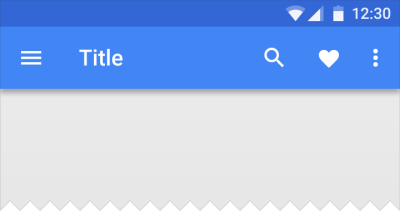
And here is what a Material Design Toolbar looks like on Android:
layout_structure_appbar_structure4

The goal here is to get something more similar to the Android Material Design look. The most notable differences are the drop shadow created by the toolbar onto the rest of the view as well as the distinct back button and other icons.

So, if you’re using Xamarin.Forms, you’ll need to create a custom renderer to get this job done. Let’s take a look at that:

MaterialNavigationRenderer.cs


[assembly: ExportRenderer(typeof(NavigationPage), typeof(MaterialNavigationRenderer))]
namespace YOUR_IOS_NAMESPACE
{
    ///
<summary>
    /// Custom renderer creating a material design navigation bar
    /// </summary>

    public class MaterialNavigationRenderer : NavigationRenderer
    {
        protected override void OnElementChanged(VisualElementChangedEventArgs e)
        {
            base.OnElementChanged(e);

            // Create the material drop shadow
            NavigationBar.Layer.ShadowColor = UIColor.Black.CGColor;
            NavigationBar.Layer.ShadowOffset = new CGSize(0, 0);
            NavigationBar.Layer.ShadowRadius = 3;
            NavigationBar.Layer.ShadowOpacity = 1;

            // Create the back arrow icon image
            var arrowImage = UIImage.FromBundle("Icons/ic_arrow_back_white.png");
            NavigationBar.BackIndicatorImage = arrowImage;
            NavigationBar.BackIndicatorTransitionMaskImage = arrowImage;

            // Set the back button title to empty since Material Design doesn't use it.
            if (NavigationItem?.BackBarButtonItem != null)
                NavigationItem.BackBarButtonItem.Title = " ";
            if (NavigationBar.BackItem != null)
            {
                NavigationBar.BackItem.Title = " ";
                NavigationBar.BackItem.BackBarButtonItem.Image = arrowImage;
            }
        }
    }
}

This will override our Renderer for all of our instances of a NavigationPage. To breakdown what is being done here, the renderer is initializing the native UINavigationBar, then updating the Layer of the UINavigationBar to create a drop shadow. After that, we instantiate the back arrow icon to replace the default iOS one. Lastly, we set the back button title to empty so that it doesn’t show up next to our new back button image.

The back button icon is taken from the official Material Design Icons from Google found here: https://material.io/icons/

The last thing we need to do is update our toolbar icon to fit the Material standards (thicker and bolder). To do this, we go back to the icons linked above and download the new check icon we want and substitute the ToolbarItem we have in our XAML.

Now we can see the results of our custom renderer and updated icon with our more Material Design looking toolbar:

Screen Shot 2017-05-16 at 12.31.37 PM


Next Steps

Want to take it further? Try updating your custom renderer to move the Title text alignment to the left and use the Roboto font! Check out this blog post on how to bring Roboto to your iOS fonts: https://alexdunn.org/2017/05/03/xamarin-tips-bringing-material-design-fonts-to-ios/.

If you like what you see, don’t forget to follow me on twitter @Suave_Pirate, check out my GitHub, and subscribe to my blog to learn more mobile developer tips and tricks!

Interested in sponsoring developer content? Message @Suave_Pirate on twitter for details.

Xamarin.Tip – Binding a Picker to an Enum

So a recent Xamarin.Forms update released the new Bindable Picker, which allows you to bind an IList of objects to the picker (which will be ToString()‘ed). However, I’ve often find myself needing to create a form for a model that has enum properties. Previously, in order to do this, I would have to create a custom List or string from my enum and map it manually, then read from the SelectedItem bound to another string property, then when I need the actual value I’d have to map it back to the enum it “represents”.

It might have looked something like this:

MyViewModel.cs

...
private DogBreed _breedEnum; // this is our enum of: BorderCollie, LabradorRetriever, PitBull, etc.

public List<string> BreedNames
{
    get
    {
        return new List<string> { "Border Collie", "Labrador Retriever", "Pit Bull" };
    }
}

private string _selectedBreed;
public string SelectedBreed
{
    get
    {
        return _selectedBreed;
    }
    set
    {
        Set(ref _selectedBreed, value); // this is using MvvmLight
    }
}

public void DoSomethingWithTheBreed()
{
    switch(SelectedBreed)
    {
        case "Border Collie": _breedEnum = DogBreed.BorderCollie;
            break;
        case "Labrador Retriever": _breedEnum = DogBreed.LabradorRetriever;
            break;
        case "Pit Bull": _breedEnum = DogBreed.PitBull;
            break;
        //...
    }

    DoSomething(_breedEnum);
}
...

And our XAML

<Picker ItemsSource="{Binding BreedNames}" SelectedItem="{Binding SelectedBreed}"/>

As you can see, this is pretty gross…

Here’s a quick little strategy I use to make the binding process a little easier with my enums. It’s broken into just 3 quick parts:

  1. Create a extension methods to get a readable string from our `enum`
  2. Create a `Converter` to convert the `SelectedIndex` to the `enum` field
  3. Wire up the fields and XAML

Let’s create our enum extension methods to get a readable string for the UI:
StringExtensions.cs

    public static class StringExtensions
    {
        public static string SplitCamelCase(this string str)
        {
            return Regex.Replace(
                Regex.Replace(
                    str,
                    @"(\P{Ll})(\P{Ll}\p{Ll})",
                    "$1 $2"
                ),
                @"(\p{Ll})(\P{Ll})",
                "$1 $2"
            );
        }
    }

This SplitCamelCase method will take a string that is camel cased and split it out into separate words such as `”ThisIsMyValue”.SplitCamelCase(); // “This Is My Value”

Now that we have the ability to get a readable string from the enum values, let’s create our ViewModel properties we will need.

MyViewModel.cs

...
private DogBreed _selectedBreed;
public DogBreed SelectedBreed
{
    get
    {
        return _selectedBreed;
    }
    set
    {
        Set(ref _selectedBreed, value);
    }
}

public List<string> BreedNames
{
    get
    {
        return Enum.GetNames(typeof(DogBreed)).Select(b => b.SplitCamelCase()).ToList();
    }
}

public void DoSomethingWithBreed()
{
    DoSomething(SelectedBreed);
}
...

So much cleaner already. Now we need to create a Converter that our XAML can use to actually set the SelectedBreed property of our ViewModel.

IntEnumConverter.cs

    public class IntEnumConverter : IValueConverter
    {
        public object Convert(object value, Type targetType, object parameter, CultureInfo culture)
        {
            if (value is Enum)
            {
                return (int)value;
            }
            return 0;
        }

        public object ConvertBack(object value, Type targetType, object parameter, CultureInfo culture)
        {
            if(value is int)
            {
                return Enum.ToObject(targetType, value);
            }
            return 0;
        }
    }

Last thing to do is use our IntEnumConverter and our properties to create our view in XAML:

MyView.xaml

<ContentPage.Resources>
    <ResourceDictionary>
        <converters:IntEnumConverter x:Key="IntEnum"/>
    </ResourceDictionary>
</ContentPage.Resources>
<Picker ItemsSource="{Binding BreedNames}" SelectedIndex="{Binding SelectedBreed, Converter=IntEnum}"/>

Here’s what we have!

Now you have the means to bind any of your Pickers quite easily to any of your custom enum fields!

“Woah! How did you get that Material Design Looking Picker on iOS”… Stay tuned!

If you like what you see, don’t forget to follow me on twitter @Suave_Pirate, check out my GitHub, and subscribe to my blog to learn more mobile developer tips and tricks!

Interested in sponsoring developer content? Message @Suave_Pirate on twitter for details.

Xamarin.Tips – Overriding Android Button Shadows/Elevation

Since Material Design’s implementation in the Android OS, some controls that ship with either the new styles, or with the App Compat packages place some under-the-cover restrictions on what you can do with the control by default. In this example, we will look at updating the App Compat Button Shadows and Elevation that ship with the control.

According to Material Design’s standards, “raised buttons” (versus flat buttons and floating action buttons) should have a resting elevation of 2dp, and an pressed/hover elevation of 8dp.

whatismaterial_3d_elevation_component02

This principle is also implemented in the App Compat Button. However, if you try to update the Elevation of your Button, you’ll notice that it won’t stay that way on the redraw, but will go right back to the 4dp it is by default.


supportButton.Elevation = 9; // set it directly
ViewCompat.SetElevation(supportButton, 9); // set using app compat method

...

Console.WriteLine(supportButton.Elevation); // will return 4...

So why is this? And how is Android creating the pressed animation automatically to increase the elevation? It certainly isn’t any code we’ve written. The answer is in the StateListAnimator property of the Button. The StateListAnimator is responsible for setting properties of the Button during certain states such as Enabled, Disabled, Focused, Pressed, etc. and is what is overriding the manual set of Button.Elevation.

You can override this in a few different ways to claim back full control. First, if you want to handle your different different states manually in your code, you can set the StateListAnimator to a new instance, or null, then set the Elevation to what you want.

In Code

supportButton.StateListAnimator = new StateListAnimator();
ViewCompat.SetElevation(supportButton, 9);

...

Console.WriteLine(supportButton.Elevation); // 9!

The most reusable way to do this is to subclass Button and set the StateListAnimator in the constructor:

CustomElevatingButton.cs

public class CustomElevatingButton : Android.Support.V7.Widget.AppCompatButton
{
    public CustomElevatingButton(Context context): base(context)
    {
        StateListAnimator = new StateListAnimator();
    }
}

Using Styles

Alternatively, you can set it using styles for your Button:

styles.xml

<?xml version="1.0" encoding="UTF-8"?>
<resources>
    <style name="AppTheme" parent="AppTheme.Base">
    </style>
    <style name="AppTheme.Base" parent="Theme.AppCompat.Light.NoActionBar">
        <item name="android:buttonStyle">@style/NoShadowButton</item>
    </style>
    <style name="NoShadowButton" parent="android:style/Widget.Button">
        <item name="android:stateListAnimator">@null</item>
    </style>
</resources>

You can also do it per-button:

 styles.xml

<?xml version="1.0" encoding="UTF-8"?>
<resources>
    <style name="AppTheme" parent="AppTheme.Base">
    </style>
    <style name="AppTheme.Base" parent="Theme.AppCompat.Light.NoActionBar">
        ...
    </style>
    <style name="NoShadowButton" parent="android:style/Widget.Button">
        <item name="android:stateListAnimator">@null</item>
    </style>
</resources>

some_layout.axml

...
<Button style="@style/NoShadowButton" ... />
...

In Xamarin.Forms

We can do the same thing in Xamarin.Forms with either a custom renderer or a custom Effect. In this example, we will create a universal Xamarin.Forms.Button custom renderer to set an explicit height:

ElevatedButtonRenderer

public class ElevatedButtonRenderer : Xamarin.Forms.Platform.Android.AppCompat.ButtonRenderer
{
    public override void OnElementChanged(ElementChangedEventArgs<Button> e)
    {
        StateListAnimator = null; // clear the state list animator
        Elevation = 9; // set the elevation
    }
}

Creating Your Own StateListAnimator

Of course, instead of clearing the StateListAnimator and handling your elevation manually, you could create your own to handle the states and animations however you want. Google has documentation included in the discussion about animations here. Here’s an example of creating and applying your own:

anim/reverse_state_list_animator.xml

<!-- animate the elevation property of a view when pressed -->
<selector xmlns:android="http://schemas.android.com/apk/res/android">
  <item android:state_pressed="true">
    <set>
      <objectAnimator android:propertyName="elevation"
        android:duration="@android:integer/config_shortAnimTime"
        android:valueTo="0dp"
        android:valueType="floatType"/>
        <!-- you could have other objectAnimator elements
             here for "x" and "y", or other properties -->
    </set>
  </item>
  <item android:state_enabled="true"
    android:state_pressed="false"
    android:state_focused="true">
    <set>
      <objectAnimator android:propertyName="elevation"
        android:duration="100"
        android:valueTo="2dp"
        android:valueType="floatType"/>
    </set>
  </item>
</selector>

This animation will do the reverse of the Material Design Standard, and will take the Button elevation from 2dp to 0dp when pressed.

Now we just need to apply this animation resource to our Button style either universally or on a specific button:

<?xml version="1.0" encoding="UTF-8"?>
<resources>
    <style name="AppTheme" parent="AppTheme.Base">
    </style>
    <style name="AppTheme.Base" parent="Theme.AppCompat.Light.NoActionBar">
        <item name="android:buttonStyle">@style/NoShadowButton</item>
    </style>
    <style name="NoShadowButton" parent="android:style/Widget.Button">
        <item name="android:stateListAnimator">@anim/reverse_state_list_animator</item>
    </style>
</resources>

Now pressing any button within the AppTheme will reverse the elevation property and go more “into” the view rather than elevating.

If you like what you see, don’t forget to follow me on twitter @Suave_Pirate, check out my GitHub, and subscribe to my blog to learn more mobile developer tips and tricks!

Interested in sponsoring developer content? Message @Suave_Pirate on twitter for details.